
Trade
TRADE — *one form becomes another. nothing made; nothing lost.*
Listen along — Trade
Loading audio…
Press play to listen along. The line being read lights up as you go.
Show full transcript
Loading transcript…
Chapter 3 — Trade and the Conversion of Energy from One Form to Another
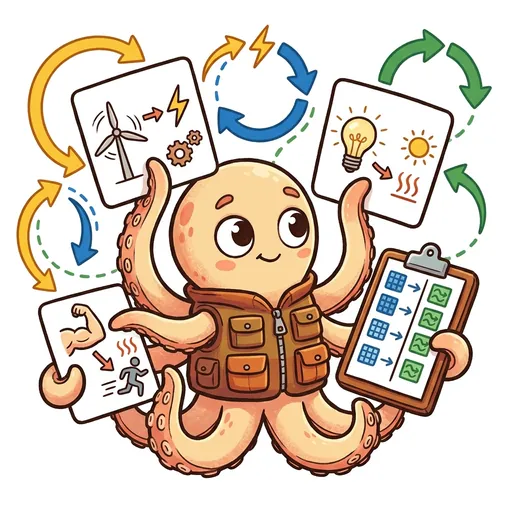
Trade, a small octopus, hummed a quiet, tuneless melody. His eight arms, a warm cream color with soft coral tints, moved with practiced ease. Each arm worked independently, yet together, like a well-oiled machine. He wore a chunky converter-vest, its pockets overflowing with small, polished cards. These cards showed diagrams of devices: a spinning generator, a glowing light bulb, a flexing muscle. Next to him, a small tally board tracked inputs and outputs. He loved watching things change. He loved saying, “One form becomes another. Nothing made; nothing lost.”
This was Trade’s whole world. He was fascinated by how energy transformed. Most people, especially the younger novices, thought energy simply disappeared. They’d say a battery “died” or a fire “used up” its heat. Trade knew better. He knew that energy never truly vanished. It only shifted its shape, like a chameleon changing its skin. This was the core of his craft: energy conversion, the art of transforming one form of energy into another.
“Pip, come here,” Trade called, his voice a gentle murmur. A younger octopus, barely a year older than Trade himself, shuffled into the workshop. Pip was still learning, often confused by the invisible forces Trade mastered.
“Watch this,” Trade said, holding up a hand-crank generator. It was wired to a small, clear light bulb. “My muscles,” he explained, flexing an arm, “are full of chemical energy from the food I ate. When I crank this handle, that chemical energy makes my arm move. That movement? That’s kinetic energy.”
He began to crank. The generator whirred, a soft, insistent sound. His arm muscles bunched and released. The small bulb flickered, then glowed with a faint, warm light.
“The kinetic energy of the spinning crank,” Trade continued, “makes a magnet spin inside the generator. That spinning magnet creates electrical energy. See the wires? They carry that electrical energy to the bulb.” He paused, letting Pip observe the dim glow. “Now, the bulb takes that electrical energy and converts it into two new forms: light energy, which you can see, and heat energy, which you can feel if you touch the bulb carefully.”
Pip leaned closer, his eyes wide. “So, my muscles… then the crank… then the electricity… then light and heat?”
“Exactly!” Trade beamed. “Five forms, all in a row. My chemical energy became kinetic energy, then electrical, then light and heat. Nothing was made from nothing. Nothing was lost into thin air. It just changed its costume.” He picked up a card from his vest, showing a diagram of a generator. “A generator converts kinetic energy into electrical energy. It’s a conversion machine.”
Trade then pointed to a different card, showing a motor. “A motor does the opposite. It takes electrical energy and turns it back into kinetic energy, like the wheels of a cart.”
He moved to a small solar panel sitting on a workbench, angled toward the workshop’s single window. Wires ran from the panel to a small battery, then to a tiny LED lamp. “The sun sends out radiant energy,” Trade explained. “That’s light, like from the bulb, but it travels through space. This solar panel captures that radiant energy and turns it into electrical energy.”
He tapped the battery. “The electrical energy then flows into this battery. Inside, it becomes chemical energy, stored up for later. When we need it, the battery converts that chemical energy back into electrical energy, which then powers this LED.” The LED glowed with a bright, clear light. “The LED converts electrical energy into light, just like the old bulb. But it creates much less heat. It’s more efficient.”
Pip looked from the dim old bulb to the bright LED. “So, the old bulb wasted more?”
“Not wasted,” Trade corrected gently. “It converted more of the electrical energy into heat. That heat wasn’t gone. It just wasn’t the useful light we wanted. Think of it like a currency exchange. You trade one type of money for another. Some exchanges cost more in fees, but the total amount of money is still there. The universe’s currency exchange is always balanced.”
Trade walked to his form-tracking tally board. He pointed to the columns. “We track the input forms and the output forms. The total energy always remains the same. This is called the law of conservation of energy. It always holds true.”
He remembered his own childhood, growing up along the deep-shelves of the ocean floor. His family had been renowned “long-form-changers” for generations. They were octopuses whose skin could shift color and texture in an instant, teaching the village that “the body has many forms; energy has many forms; the trick is knowing the conversion between them.” Trade had absorbed their lessons like water.
When he was twelve, he had gone to PowerForge, the central hub for all energy craft. Volt, the wise elder, had asked him, “What is energy conversion?” Trade had answered without hesitation, “One form becomes another. Nothing made; nothing lost. It’s form-changing-craft.” Volt had simply nodded. “You are appointed,” he had said.
Now, in his own workshop, Trade continued his gentle teaching. “Many people say a battery ‘dies.’ But it doesn’t die. Its stored chemical energy has simply been converted into electrical energy, which then became light or heat or sound somewhere else. It’s still energy. It just changed its form.”
He picked up a small, smooth stone. “Even this stone has gravitational potential energy when I hold it high. If I drop it, that becomes kinetic energy as it falls, then sound and heat when it hits the floor. Every action, every device, every living thing is a converter.”
Trade looked at Pip, a serious expression on his face. “Don’t think energy gets ‘used up.’ Instead, think: where did it go? Every device is a converter. The ‘wasted’ energy is usually heat, still energy, just less useful for the task at hand. Conservation says: input equals output, always. Efficiency tells you how much of the output is useful.”
He smiled. “One form becomes another. Nothing made; nothing lost.”
The PowerForge ensemble
Trade is part of PowerForge's distributed-narrative cast. Each character embodies a different curricular primitive; together they teach the full subject.