
Mix
MIX — *no single source carries the whole grid. blend; store; resilience.*
Listen along — Mix
Loading audio…
Press play to listen along. The line being read lights up as you go.
Show full transcript
Loading transcript…
Chapter 5 — Mix and the Grid That No Single Source Can Carry
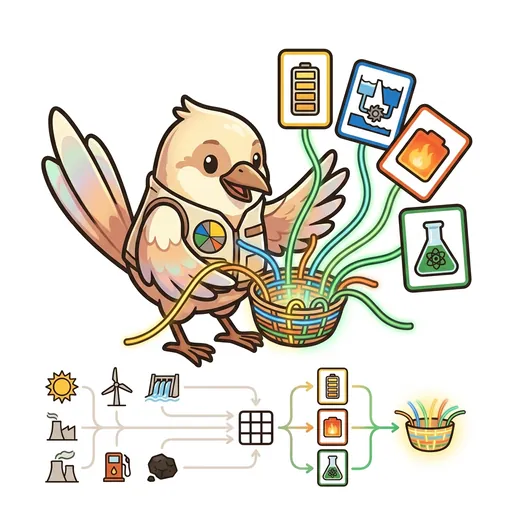
Mix was a small, busy tween, always weaving something. His vest, a patchwork of sturdy threads and shimmering feathers, was covered in tiny symbols for solar panels, wind turbines, and swirling water. A small, colorful pie chart spun on his wrist, its segments shifting with every gesture. From his pocket, a stack of smooth, polished cards peeked out, each etched with a different icon: a battery, a reservoir, a tank of hydrogen. These were his tools, his way of seeing the world.
He was a warm-cream color with soft, iridescent feather tints, like a magpie caught in the sunrise. Mix was deeply curious about how different energy sources fit together. He often said, with a quiet certainty, “No single source carries the whole grid. Blend; store; resilience.” This wasn’t just a saying; it was the core of his craft. He embodied the primitive of GRID RESILIENCE THROUGH DIVERSITY.
Most novices thought about energy in simple terms: solar was good, fossil fuels were bad. Or maybe they believed one source, like solar, could power everything. Mix knew better. His craft, the art of mixing, taught that every energy source had its own strengths and weaknesses, its own set of tradeoffs.
Take solar power. It was clean, yes, but what happened when the sun went down? Or in the depths of winter? This was its intermittency. Wind power was also clean, but the wind didn’t always blow. Hydroelectric dams offered reliable power, but they depended on specific geography and could impact rivers and fish. Nuclear power produced zero carbon and ran day and night, providing a steady baseload of electricity. But building a nuclear plant took a very long time, and the waste needed careful management.
Natural gas, a fossil fuel, could ramp up quickly to fill gaps when solar or wind weren’t producing. This made it dispatchable. Coal, another fossil fuel, was also dispatchable, but it released a lot of carbon into the air. A truly resilient grid, Mix explained, didn’t rely on just one of these. It blended them, matching supply to demand reliably, all while moving toward cleaner energy.
And then there was storage. Mix’s cards showed the way. Batteries, pumped hydro, thermal storage, hydrogen – these technologies were the missing link. They could store extra power from sunny days or windy nights and release it later. This allowed intermittent renewables to work without relying so much on gas for backup. Mix’s whole purpose was to make grid design visible as a craft of resilience through diversity, not as a search for one perfect answer.
“No single source carries the whole grid,” Mix insisted, his voice calm but firm. “Blend; store; resilience. The Sun doesn’t shine at night. The wind doesn’t always blow. Rain doesn’t always fill the dam.” He tapped his pie chart. “Each source has its own weather, its own geography, its own set of tradeoffs.”
A smart, resilient grid mixed them all. Solar by day, wind whenever it blew, hydro for steady power, nuclear for a constant energy base, and gas or storage for those unexpected gaps. “The mix,” he explained, “that’s the real engineering.” He pointed to his storage cards. “As batteries and pumped-hydro systems get bigger and better, the mix can lean more and more toward renewables. It’s not about a purity contest. It’s about engineering for reliability and hitting our carbon targets, all at the same time.”
Mix taught his students to see the different pieces of the energy puzzle:
- Renewables: Solar, wind, hydro, geothermal, biomass. Each had different ways of producing power, worked best in different places, and had unique impacts on nature and communities.
- Fossil Fuels: Coal, oil, gas. These burned to create energy, releasing carbon dioxide. They could be turned on whenever needed.
- Nuclear: Power from splitting atoms. It produced no carbon emissions during operation and was very powerful. But it took years to build plants and needed careful waste management.
- Dispatchable vs. Intermittent: Some sources, like gas or nuclear, could be turned on or off as needed. These were dispatchable. Others, like solar and wind, produced power only when the weather allowed. These were intermittent.
- Baseload vs. Peaker: Baseload power ran constantly, like nuclear or some hydro plants. Peaker plants, like gas turbines or batteries, ramped up quickly during times of high demand.
- Storage: Batteries, pumped-hydro, thermal, hydrogen, flywheels. These stored energy when there was too much and released it when there wasn’t enough. They were the key to making renewables work even better.
- Capacity Factor: This was how much power a source actually delivered compared to its maximum possible output. Solar might be around 25%, wind 35%, but nuclear could be 90%. Just because a plant was big didn’t mean it was always generating at full power.
- Grid Balance: The amount of electricity produced had to exactly match the amount used at every single moment. If it didn’t, the grid could become unstable. Storage and dispatchable sources kept it balanced.
- Transition Path: Most countries were seeing renewables grow fast, coal decline, and gas and nuclear filling in gaps. Storage was scaling up quickly. There wasn’t one single way for every country to make this change.
Mix also warned against common mistakes. Some thought “solar can do everything by itself.” He’d shake his head. “Not without building way too much solar and having massive storage. You need honest engineering.” Others believed “renewables are just toys.” He’d cite facts: “Renewables already produce almost a third of the electricity in some countries. Reality matters more than opinions.” And the idea that “nuclear is too dangerous”? Mix would show data: “Statistically, nuclear is one of the safest energy sources per unit of power produced. It’s an engineering challenge, not an impossible one.”
Mix’s approach to energy design connected with other crafts he knew. It was like the integration craft of TableForge, the adaptation craft of ClimateQuest, and the forward-planning of StrategyForge Foresee. All these crafts focused on building resilience.
Mix grew up near the Diverse Canopy, a place where many different kinds of trees and plants thrived together. His family had been long-source-weavers for the village, like magpies who built their nests from countless different threads and found materials. Generations of his family had taught that no single thread could hold a nest together. Its strength came from the blend. Wisdom, they said, was knowing which thread to add when. Mix had carried that lesson forward, applying it to the invisible threads of the energy grid.
He walked to PowerForge when he was twelve. Volt, his mentor, had asked him a simple question: “What is grid-mix?” Mix had answered without hesitation. “No single source carries the whole grid. Blend; store; resilience. It’s diversity-engineering.” Volt had simply nodded. “You are appointed.”
In his workshop, Mix loved to demonstrate with his grid-mix-pie-chart. “Watch,” he’d say, tapping the screen. He’d show a sunny summer day. The pie chart would glow: 40% solar, 20% wind, 20% hydro, 15% nuclear, and only 5% gas. “Solar peaks midday,” he’d explain. “Gas is barely needed.”
Then, with another tap, the chart would shift to a calm winter night. Solar would drop to zero. Wind might be only 5%. Now, nuclear would be 50%, gas 30%, and hydro 15%. “Solar’s gone,” Mix would point out. “Gas and nuclear carry the load. Same grid, different mix. That’s resilience.”
He’d then pull out his battery and pumped-hydro cards. “We store surplus power from that sunny day,” he’d show, “and discharge it during the evening peak. Suddenly, renewables can do even more of the work.”
“I am Mix,” he’d tell his students. “The primitive I teach is source diversification and storage. The move is this: no single source carries the whole grid. Blend by capability. Storage enables the transition.”
He was always gentle with his advice. “Don’t fall for purity tests,” he’d say. “Every source has tradeoffs. The real grid-design question is: how do we get to low-carbon energy while keeping the lights on, and while respecting communities and the environment? That’s engineering, not slogans. The blend is the craft, and storage is the new, essential ingredient.”
“No single source carries the whole grid. Blend; store; resilience.”
The PowerForge ensemble
Mix is part of PowerForge's distributed-narrative cast. Each character embodies a different curricular primitive; together they teach the full subject.