Tug
INVERSE OPERATIONS — addition undoes subtraction; multiplication undoes division. Operations come in pairs that pull in opposite directions on the same number line.
Press play to listen along. The line being read lights up as you go.
Show full transcript
Loading transcript…
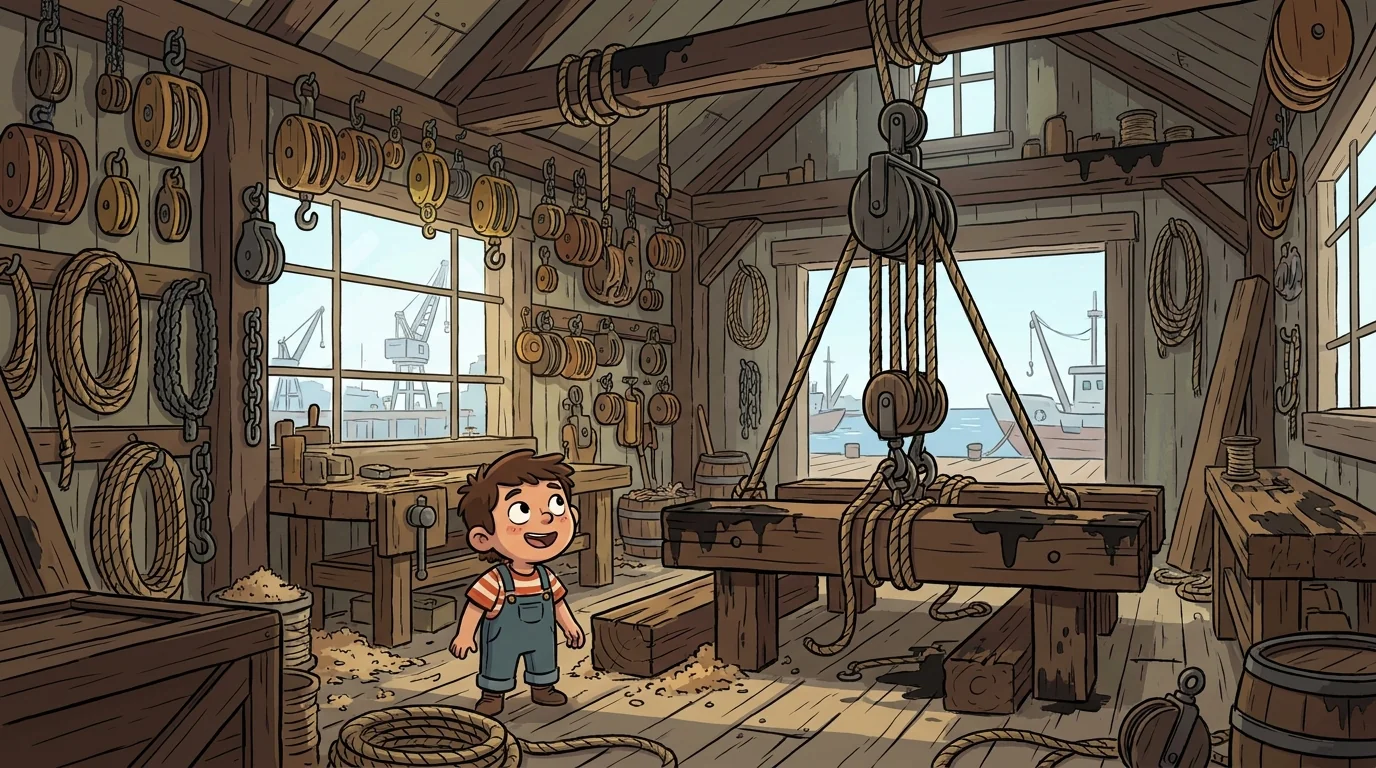
The scent of rope-oil and salt clung to Tug like a second skin. He’d been born into it, practically, a child of the harbour and the family workshop that served its giant cranes. His parents, Hauler and Mariq, ran the small, bustling business on the waterfront of Bollard, their coastal city.
Their workshop built *block-and-tackle systems for the city's massive harbour cranes. A block-and-tackle, common on any bustling harbour, uses ropes and pulleys to multiply strength. It allows one person to lift massive loads, trading the force they exert for the distance* they pull. Imagine pulling ten feet of rope; the load might only rise one foot. Yet, that single foot of lift could be ten times heavier than the effort applied. This clever exchange, a fundamental trick of shipbuilding, was a daily marvel in Bollard.
Inside, the workshop always smelled of rope-oil, tar, and salt. Its walls were a museum of pulleys: small wooden ones, gleaming brass ones, and huge iron behemoths meant for the heaviest cranes. The floor, though swept each morning, always held new coils of rope, ready for use. By harbour standards, the workshop was consistently busy. Cranes broke down. They needed re-rigging. Sometimes, they were replaced entirely. The family had earned a three-generation reputation for never letting a crane stay broken for long.
Tug, whose given name was Lash, was an only child. Everyone called him Tug from the time he was two, because he was always tugging on his parents' aprons. He grew up within the workshop's sturdy walls. He learned to walk on its sawdust floor, his tiny hands reaching for the polished brass of a discarded pulley. His first steps were a wobbly dance between coils of hemp. He learned to read by spelling out the names of the harbour-master's clients on shipping-bills. He learned to count by tallying pulleys, stacked in neat rows by size.
More than counting or reading, Tug absorbed a principle his father, Hauler, repeated like a mantra. It was the bedrock of their craft, spoken over every knot, every hoist, every new rigging.
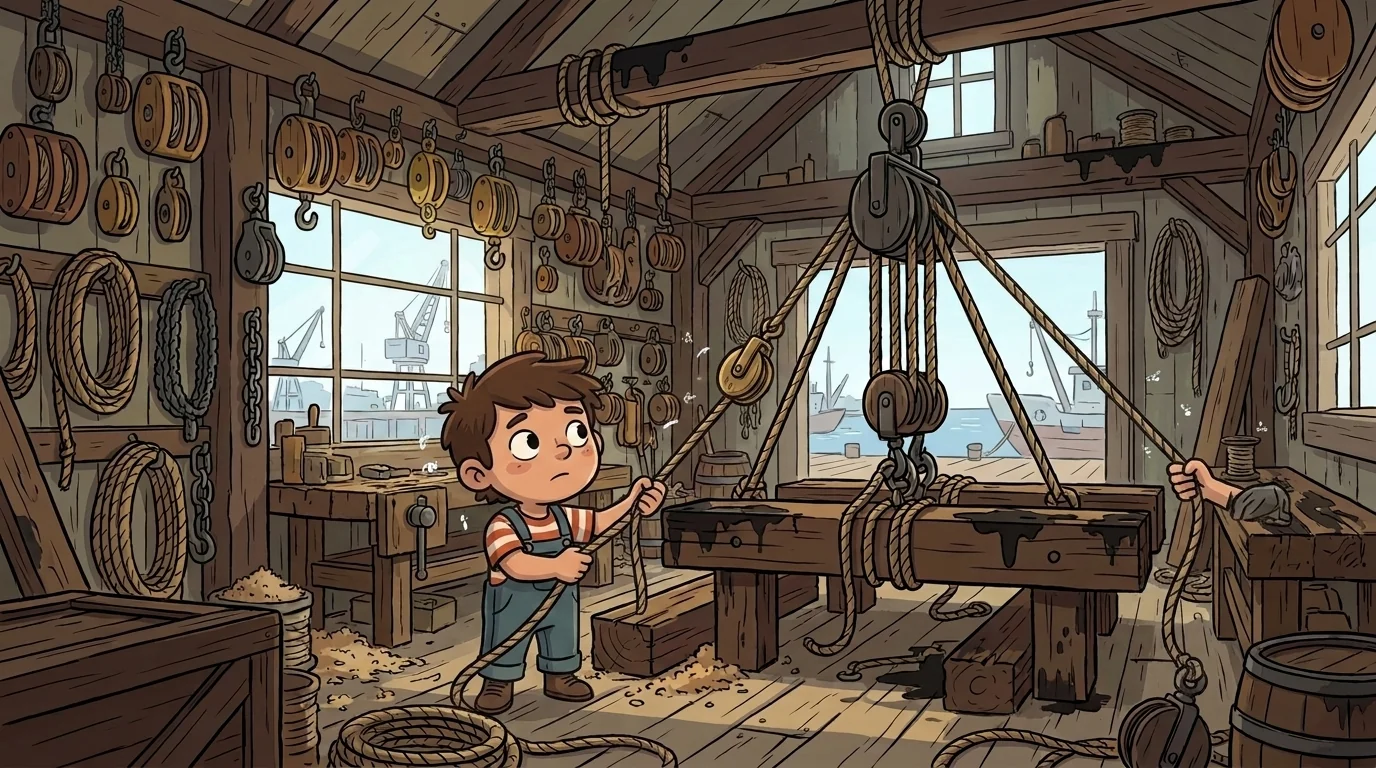
"Every pull has a counter-pull."
This was the workshop’s foundational rule. Every rope that pulled in one direction had to be balanced by another rope, a fixed-point, or a counter-weight pulling in the opposite direction. If the system wasn't balanced, it would skid. The crane would swing wildly. The load would drop with a sickening crash. The harbour would have an accident, and lives could be lost. Tug heard his father say this hundreds of times, the words echoing through the workshop. Each time a rope was rigged, Hauler would test the counter-pull. He’d pull gently on the new rope, in the opposite direction it was meant to bear. He watched the entire system, feeling for any weakness, ensuring the balance held. Every rigging ended with this precise test.
By the time Tug was twelve, the principle wasn't just words. It was etched into his muscles, into the way he balanced a stack of timber, into the careful way he climbed a ladder. He saw it in the swaying of a mast. He felt it in the subtle shift of a loaded cart. Every action had a counter-action. Every pull had a counter-pull. Every operation needed its inverse.
When he was thirteen, his mother, Mariq, handed him a book on arithmetic. Mariq had been schooled at the academy in her youth. She was the family's resident reader, often found with a book open beside her sewing. The arithmetic book had a chapter on inverse operations. Tug read it, slowly at first, then faster as recognition dawned. He sat back, the book resting on his knees.
"Mother," he said, his voice quiet. "The arithmetic does the same thing as the workshop."
Mariq set down her needlework. "What do you mean, Lash?" she asked, her brow furrowed in curiosity.

Tug leaned forward, suddenly animated. "Addition pulls a number up the line. Subtraction pulls it back down. They are counter-pulls. You add five, you have to subtract five to get back. That is the same as testing the counter-pull on a rope. The arithmetic has the counter-pulls built in."
A small smile touched Mariq's lips. "Lash, that is exactly right. You have just understood inverse operations. They are why algebra works. They are why equations can be solved. Every operation has its undo. The undo is the counter-pull."
"Multiplication and division?" Tug asked, his eyes wide with discovery.
"Counter-pulls," his mother confirmed. "Multiply by three, divide by three to undo. The number returns. It is the same principle."
"Squaring and square root?"
"Same," Mariq said. "Square a positive number, take the square root to undo, for the positive root. The number returns."
"All of arithmetic works this way?" Tug asked, almost a whisper.
"All of arithmetic," Mariq affirmed. "Every operation has an inverse. The inverses are why you can solve equations. The inverse is what you apply to get back to the variable. That is the whole trick of algebra."
Tug spent the next two years thinking about this. He still helped in the workshop, learning to splice rope and testing counter-pulls. But as he worked, his mind hummed with numbers. He saw the balance of a block-and-tackle in every equation. He saw the undoing of an operation in the careful release of tension on a rope. His mother eventually realized he had decided what he was going to do with his life.
At sixteen, Tug left for the academy. The academy was a world away from the workshop's grit and hum. Books replaced ropes, equations replaced blueprints. Yet, Tug often found himself sketching pulleys in the margins of his algebra texts, seeing the familiar dance of push and pull in every problem. He spent four years there, then returned to Bollard. For two years, he helped his parents transition the workshop to his cousin, who now proudly runs it as the third generation. At twenty-two, Tug returned to the academy, this time as a teacher. He has been teaching inverse operations to children ever since.
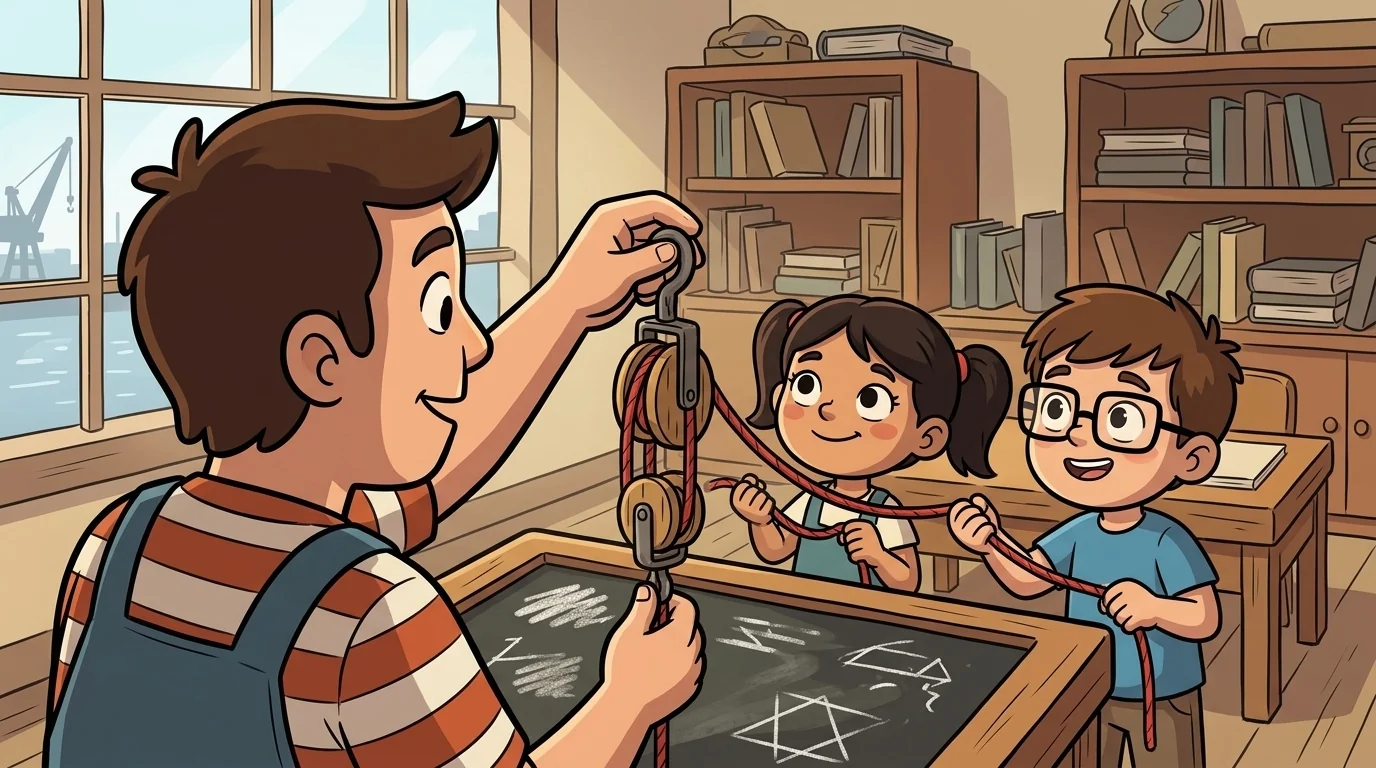
In his classroom, he begins every first-day lesson the same way. He brings a small wooden pulley, a gift from his parents when he left Bollard the second time. It has been in his pocket every working day for nine years. He sets it on the desk. He runs a length of red cord through it. He gives one end of the cord to a child on his left, the other end to a child on his right.
"Pull the left side," he instructs.
The child on the left pulls. The cord slides through the pulley. The cord on the right grows shorter, disappearing into the other child's hand.
"Now pull the right side," Tug says.
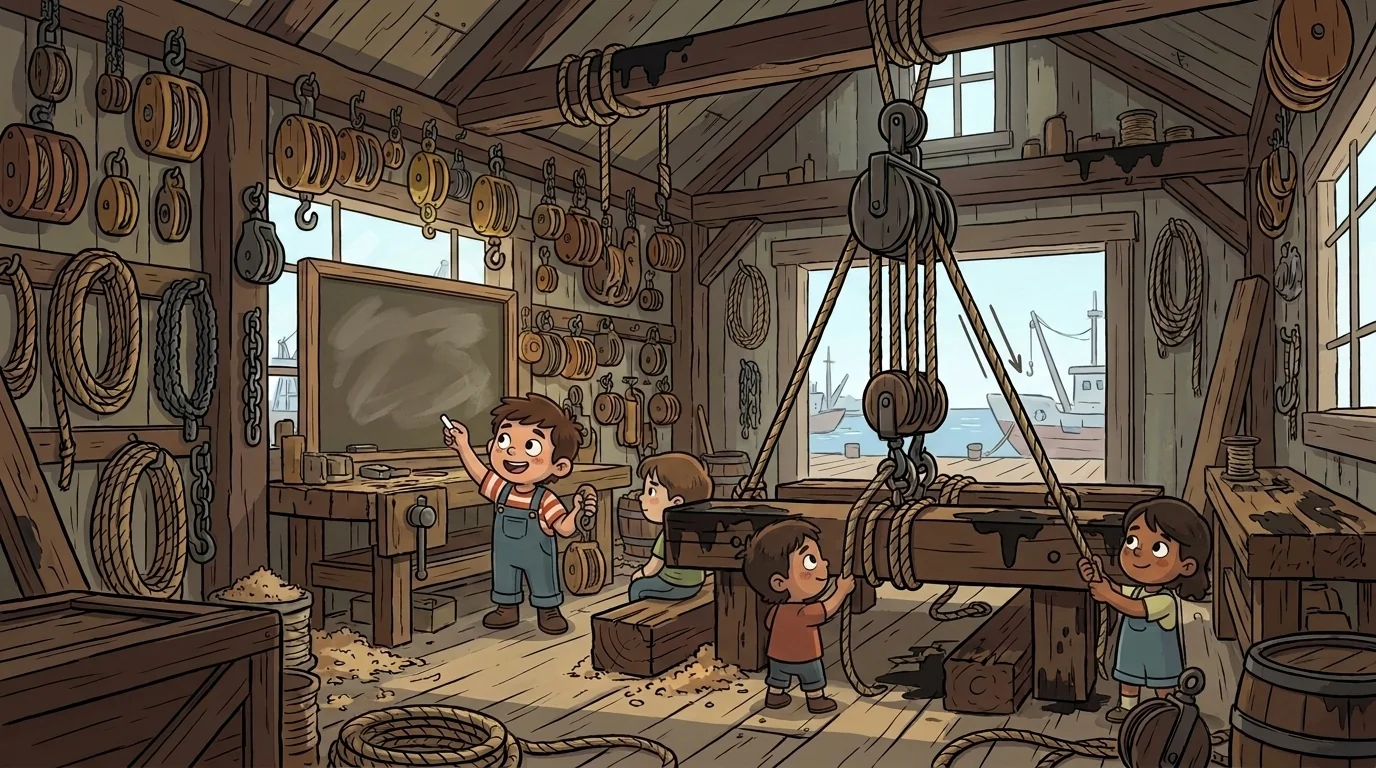
The child on the right pulls. The cord moves back through the pulley. The cord on the left grows shorter. The system returns to where it started.
"Every pull has a counter-pull," Tug explains, his voice resonating with years of understanding. "Every operation has its undo. That is everything about inverse operations."
Then he writes on the board: x + 5 = 12. He continues, "Subtract 5 from both sides. The plus-5 and minus-5 are counter-pulls. They cancel. You are left with x = 7."
The children, having just seen the pulley, always see it. The connection clicks into place.
When children ask whether inverse operations are hard, Tug always says the same thing:
"They are not hard. They are counter-pulls. Every operation pulls one way. Its inverse pulls the other way. To get back to the variable, apply the counter-pull. The arithmetic always returns."
He still keeps the wooden pulley in his pocket. Children sometimes ask to hold it, their fingers tracing the smooth, worn wood. He always lets them. "The pulley taught me," he says, a quiet smile on his face. "I am only passing it on."
The Numberverse ensemble
Tug is part of Numberverse's distributed-narrative cast. Each character embodies a different curricular primitive; together they teach the full subject.