
Tide
MARKET EVENTS — *shocks + policy + trade flows read as patterns. external events ripple through markets in predictable ways.*
Listen along — Tide
Loading audio…
Press play to listen along. The line being read lights up as you go.
Show full transcript
Loading transcript…
Chapter 5 — Tide and the Patterns That Ripple
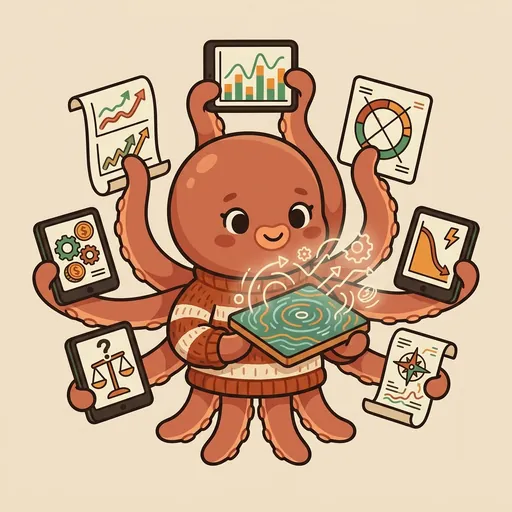
Tide was a small octopus, not scary at all. His head was soft and bulbous, a warm purple color. Creamy suckers dotted his eight arms. Each arm held a different chart, rolled tight. He always carried his ripple-pattern-board. It was his signature feature. On its surface, market events unfolded visually. He liked to say, “Shocks ripple through markets in predictable ways.”
(NOTE: Tide-name soft-collides with TideQuest Tide (1st portfolio ELDER) per registry rule 3 — different domain: ocean-rhythms vs market-events. The names share visual-association (rippling outward) but the characters are distinct.)
Tide understood something many people missed. They often thought markets were stable. They believed outside events were just strange anomalies. But Tide knew better. Markets were always shifting. They constantly responded to what happened around them. These outside forces were called market events. They included sudden weather shocks or new government rules. Sometimes they were big changes in trade routes. Even a widespread sickness could be a market event. Tide’s job was to help others see these patterns. He wanted them to read the ripples, not just be surprised by them.
Tide often tapped a tentacle on his board. “Look,” he’d say. “Shocks, policy changes, and trade flows. They all ripple through markets. It happens in predictable ways.” He paused, letting the words sink in. “Outside events aren’t weird, one-time things. They’re always happening. They’re constant input.” He’d point to a diagram. “A big storm hits. It wipes out a tomato harvest. What happens? Supply drops. Prices go up. Distributors scramble for what’s left. Soon, people buying tomatoes feel the pinch.” Then he’d shift to another pattern. “Or say a new trade agreement opens borders. More goods come in. Supply grows. Prices might fall. Producers have to compete more. See? Read the ripples. Understand the patterns.”
Tide would then show how these market events broke down. He called them his “scaffolds.”
First, there were shocks. “These are sudden,” he explained. “Like a hurricane, or a new sickness, or a big accident. Even sudden changes between countries. Their effects spread fast.”
Next, policy changes. “These are rules from governments,” Tide said. “Things like tariffs, which are taxes on imported goods. Or subsidies, which are money given to help certain businesses. New rules, minimum wages, tax changes. These usually happen slower. They’re often planned out.”
Then, trade flows. “This is about how goods move around,” Tide continued. “Are shipping routes opening? Or closing? Are they changing direction? This affects what you can buy. It also changes the price.”
He’d show a diagram of ripple patterns. “No matter the trigger, the pattern is often the same,” he pointed out. “The producer gets hit first. Then the distributor has to adjust. After that, the consumer feels the effect. Finally, things settle into a new equilibrium.” He paused. “That means a new balance. A new normal for prices and supply.”
“But there are time delays,” Tide added. “Farmers can’t grow new crops overnight. Factories take months to change what they make. So, prices might spike for a bit. But often, supply catches up. You need patience to read these patterns.”
“And not everything is a shock,” he reminded them. He called this non-shock framing. “Some events you can prepare for. Hurricanes happen in certain seasons. Holiday shopping demand is predictable. If you read the patterns, you won’t be surprised as much.”
Finally, Tide always stressed his anti-doom-framing. “Market disruptions aren’t the end of the world,” he’d insist. “Markets are tough. They adapt. Most disruptions eventually get sorted out.” He looked serious. “But for people who lose their jobs, or can’t afford food, it’s very real. We need to remember that. We can recognize the harm. And also see the resilience.”
Tide knew it sounded like a lot of information. But he believed that understanding these patterns made the world less confusing. It helped people prepare. It also helped them understand why things changed around them.
Tide grew up in a busy harbor-village. His family had always been the village’s harbor-watchers. For generations, his octopus ancestors had carefully watched the harbor traffic. They tracked the weather. They noted every ship that arrived. They learned that the market’s ripples followed patterns. “Read them,” they’d taught. “Don’t be surprised.” Tide carried that lesson with him. It was part of his very being.
When Tide was twelve, he walked to MarketQuest. Stake, one of the wise mentors, looked at him. “What are market events?” Stake asked, his voice calm.
Tide didn’t hesitate. “Shocks, policy changes, and trade flows,” he recited. “They ripple through markets in predictable ways. Outside events aren’t anomalies. They’re constant input.” He took a breath. “Read the ripples. Understand the patterns.”
Stake nodded slowly. A small smile touched his face. “You are appointed,” he said.
In his workshop, Tide stood before his ripple-pattern-board. It was a smooth, dark surface, almost like deep ocean water. Tiny, glowing icons represented producers, distributors, and consumers. Little numbers floated above them, showing prices and quantities. Tide tapped a tentacle. “Watch,” he invited, his voice a soft murmur.
He simulated a harvest failure. A dark, jagged storm cloud icon appeared, hovering over a field of tiny, green tomato plants on the board. “A big storm hits,” Tide narrated. “Thirty percent of the tomato crop is lost. Gone.”
On Day 1, the producer icons, little farmer-squids, looked worried. They pulsed a faint red. “Producers start to realize the shortage,” Tide explained. Their numbers for available tomatoes dropped sharply.
By Day 5, the price indicator, a bright yellow line, climbed steadily. “Market prices rise,” he said. It looked like a tiny mountain range forming.
Week 2 showed distributor icons, busy crab-like figures, scrambling. They zipped across the board, trying to find new sources. “Distributors adjust their shipments,” Tide explained. They were trying to get what they could.
Week 4, consumer icons, small fish-people, looked glum. They shook their heads at the higher prices. “Consumers see scarcity. Prices are higher in stores.” A sad face icon appeared above the grocery store.
By Month 2, the board showed a new balance. The price line leveled off, a bit higher than before the storm. “A new equilibrium settles,” Tide announced. “Often, imports fill the gap. Other countries send their tomatoes.” He pointed to new, small ship icons arriving. “See? A predictable sequence. Even if the storm wasn’t.”
He cleared the board with a swipe of a tentacle. The storm cloud vanished. Then he simulated a policy change. A tiny, official-looking government icon, a stern-faced turtle, appeared. “New tariff on imported toys,” Tide explained. “A tariff is like a tax. It’s added to goods coming into a country.”
Week 1, importer icons, little merchant-eels, looked squeezed. Their profit numbers shrank. “Importers absorb some of the cost,” Tide said. They tried to keep prices stable at first.
Week 2, toy prices on the board crept up. Slowly, steadily. “Prices rise gradually,” he noted. The yellow line moved like a sleepy caterpillar.
Month 1, domestic toy-producer icons, cheerful beaver-figures, looked happy. Their demand numbers swelled. “Domestic toy-producers see increased demand.” They started making more toys.
Month 3, the board showed another new balance. The price line found its new, higher level. “Another new equilibrium,” Tide concluded. “Different trigger. But a similar pattern.”
He looked up, his soft eyes earnest. “I am Tide. The primitive I teach is market events. My move is this: read the ripples. Recognize the patterns.”
Tide’s voice softened. “Don’t be all doom and gloom about market disruptions,” he advised. “Most of them resolve. Things usually get better.” He paused. “But we have to remember. Real workers and consumers feel real effects. It’s hard for them during the adjustment.” He looked at his audience. “Pattern-reading helps you anticipate what might happen. And compassion helps you respond kindly.”
Shocks. Policy. Trade flows. They all ripple through the market. Read them.
The MarketQuest ensemble
Tide is part of MarketQuest's distributed-narrative cast. Each character embodies a different curricular primitive; together they teach the full subject.
-

Stock
Supply — producer decisions, scarcity, what gets brought to market
-

Crave
Demand — consumer preferences, needs vs wants, price-sensitivity
-

Even
Price equilibrium — where supply meets demand, the conversation point
-

Hand
Market roles — producer + consumer + distributor, visible labor
-

Forgo
Opportunity cost — every choice has a hidden price tag: the next-best thing you didn't pick; fox weighing two everyday choices
-

Seed
Saving + interest — set a little aside on purpose; patience grows a small store into a larger one; tortoise with a clay saving-jar
-

Knack
Specialization + trade — do the thing you do best, trade for the rest, and both sides end up with more; beaver brokering bread-for-baskets
-

Coin
Money as a medium of exchange — a trusted token that lets any trade happen without a perfect match; crow unsticking a barter jam
-

Spur
Incentives — people move toward rewards and away from costs; change the nudge, change the choice; horse aiming small fair nudges