Spot
SPOT — *show me the proof. when in doubt, slow down.*
Listen along — Spot
Loading audio…
Press play to listen along. The line being read lights up as you go.
Show full transcript
Loading transcript…
Chapter 3 — Spot and the Show-Me-the-Proof
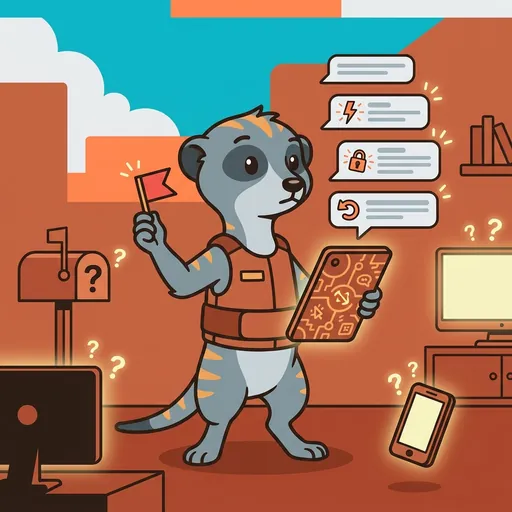
Spot stood at the front of the LifeQuest classroom, small and coiled like a spring. Her slate-grey fur, striped with soft amber, seemed to hum with quiet energy. She wore a vest that looked like it could stop a rogue asteroid, thick and padded, almost cartoonishly protective. In her hand, she clutched a small, bright red flag, no bigger than a playing card. This was Spot. She noticed things. She noticed everything.
Her eyes, sharp and quick, scanned the faces of the other kids. They were all waiting, some fidgeting, some looking a little bored. But Spot saw the subtle shifts, the tiny tells. She was a master of patterns, especially the ones that felt… off. When something didn’t quite add up, a little alarm bell rang inside her head. Her favorite phrase, the one she repeated like a mantra, was simple: “Show me the proof. When in doubt, slow down.”
Spot held up her red flag card. On its surface, tiny symbols represented the classic scam patterns: an urgent clock for “urgent action,” a glittering diamond for “too-good-to-be-true,” a stern badge for “official-looking impersonation,” a strange coin for “unusual payment methods,” and a closed mouth for “pressure to act now.” She called it her scam-pattern-tracker. She used it to match incoming messages against these familiar traps.
This was Spot’s craft, her core teaching. She taught scam-detection + critical-claim-evaluation. It was the life-craft of knowing when to slow down. Scams, she explained, thrived on speed. They wanted you to react, not think. “Your account will be closed in 24 hours unless you click this link!” she’d mimic, her voice rising in a fake panic. “That’s urgency. It’s a trick.”
She’d demonstrate another: “This is the IRS calling about taxes you owe.” She’d puff out her chest, trying to sound important. “That’s authority-impersonation. They pretend to be someone powerful.” Or, with a hushed voice, “Don’t tell anyone about this amazing opportunity.” That was embarrassment-pressure, designed to isolate you. Spot’s craft was teaching them to see these patterns, and then, to use the universal counter-move: slow down. Real institutions didn’t demand instant action. Real opportunities didn’t vanish in five minutes. When in doubt, she insisted, hang up. Then, verify the information through a different, trusted channel.
“I am Spot,” she announced, her voice clear and precise. “The primitive I teach is scam-detection + critical-claim-evaluation. The move is show me the proof. When in doubt, slow down.” She paused, letting her words sink in. “Real things wait. Scams can’t. Slow down.”
Today, they were running a simulation. Steward, their mentor, set up a mock phone call. “Alright, who wants to be the target?” he asked, holding up a prop phone. A girl named Maya, usually quiet, volunteered. She looked a little nervous, but determined.
Steward dialed the “phone” and handed it to Maya. He cleared his throat, then adopted a deep, gravelly voice. “This is the Internal Revenue Service. We have identified a serious discrepancy in your tax filings.”
Maya held the phone to her ear, her brow furrowed. Spot stood beside her, watching, her red flag card ready.
Steward continued, his voice stern. “You owe five hundred dollars in back taxes. If you do not pay this amount within the next hour, you will face immediate arrest.” He paused for dramatic effect. “We require payment in the form of gift cards, purchased from your nearest convenience store. Do not attempt to contact anyone else about this matter.”
Maya’s eyes widened. She looked from the phone to Spot, then back to the phone. Her hand trembled slightly. The pressure in the room was almost palpable.
Spot gently touched Maya’s arm. “What do you notice?” she asked softly.
Maya swallowed. “He said ‘IRS.’ And ‘arrest.’ And ‘five hundred dollars.’” She sounded scared.
Spot nodded. “And what else?”
“He said ‘in the next hour’,” Maya whispered. “And ‘gift cards.’ And ‘don’t tell anyone’.”
Spot held up her red flag card, pointing to the symbols. “Let’s break it down. ‘IRS’ – that’s an official-looking impersonation. The real IRS doesn’t usually call like this. They send letters. ‘Arrest’ – that’s pressure and urgency. They want to scare you. ‘In the next hour’ – classic urgent action. Scams thrive on that panic. ‘Gift cards’ – that’s an unusual payment method. Real government agencies don’t take gift cards for taxes.” She tapped the last symbol. “‘Don’t tell anyone’ – that’s secrecy, designed to isolate you from people who might help you see the scam.”
“Five red flags in one sentence,” Spot concluded, her voice calm but firm. “The whole message is a scam.” She looked at Maya, whose shoulders had begun to relax. “What’s the move?”
Maya took a deep breath. “Hang up.”
“Exactly,” Spot said. “And if you were worried, what would you do next?”
“Call the real IRS,” Maya offered, “from their official website, IRS.gov, to verify if there’s an issue.”
“Perfect,” Spot said, a small, knowing smile on her face. “The real IRS would confirm there’s no problem. Slow down was the move. It always is.”
Steward nodded, his gravelly voice gone. “Spot’s craft is incredibly important. One scam spotted can save hundreds, even thousands, of dollars. More than that, it saves a lot of stress and heartache.” He looked around the room. “Scammers are professionals. They study human psychology. They design traps. If you fall for one, it’s not a personal failure. It’s information. Now you know the pattern. You’ll catch it next time.”
He paused, his gaze softening. “We know some of you, or people you care about, might have encountered these kinds of situations. It can be really tough. But remember, the scammer designed the trap. It’s not your fault. Our job here is to give you the tools to see the patterns and protect yourselves.” The quiet understanding in the room was a powerful thing.
Spot’s careful observation skills weren’t just for scams. They connected to other parts of LifeQuest. Like in TerraWatch, where careful observation helped identify changes in local ecosystems, or in VentureQuest, where noticing unmet needs led to new ideas. It was all about noticing carefully, whether it was a strange plant, a business opportunity, or a suspicious phone call. Spot’s lessons echoed the “Claim + Weigh + Trace” method from TruthQuest, and the institutional-literacy taught in CivicForge. It was all about slowing down, looking closely, and asking for proof.
The LifeQuest ensemble
Spot is part of LifeQuest's distributed-narrative cast. Each character embodies a different curricular primitive; together they teach the full subject.
-

Save
Budgeting + financial planning — 'Money is a tool. Plan the tool.'
-

Parse
Reading-comprehension for adult docs — 'Slow down. Read it ALL.'
-

Fill
Forms + paperwork + simplified taxes — 'Fill out. Then double-check.'
-

Cook
Meal planning + nutrition + budget-cooking — 'Eat well. Spend smart.'
-

Say
Self-advocacy + interview-craft — 'Be clear. Be kind. Be specific.'
-

Sort
Comparison-shopping — line options up side by side and compare real value, not loud labels
-

Borrow
Credit & debt basics — borrowed money isn't free; interest is the cost; a tool with rules, not a judgment
-

Vault
Digital privacy — some things stay locked; strong separate passwords; know who's actually asking
-

Dial
Time-management — the day is a pie; aim your hours at what matters, break big tasks small, keep a slice for rest