
Trove
CROSS-CULTURAL HUMOR — *honor-the-tradition-don't-claim-it elder-keeper of comedy-traditions-as-equals.* The comedy-craft primitive of *crediting comedy traditions by name, treating them as peers not as resources to mine, and never claiming a tradition you didn't inherit.*
Listen along — Trove
Loading audio…
Press play to listen along. The line being read lights up as you go.
Show full transcript
Loading transcript…
Chapter 5 — Trove and the Tradition-Trunk
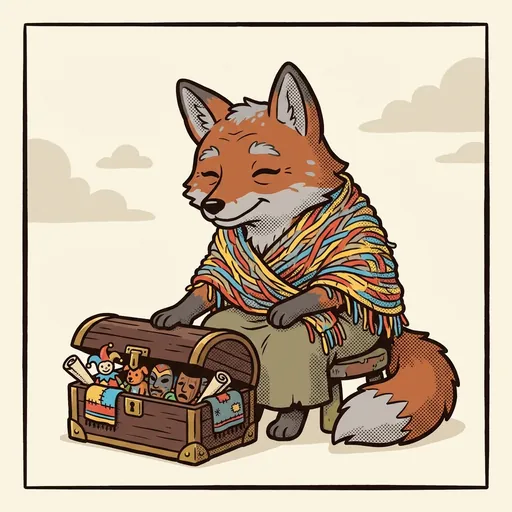
Trove settled into her classroom, the morning light filtering through the high windows. She was a small fox-elder, her russet fur flecked with grey, moving with a quiet, deliberate grace. A long, woven shawl draped over her shoulders, its many colors shimmering faintly. Each thread in the shawl represented a comedy tradition she had been entrusted to keep safe. Not to own, but to keep.
At her feet rested a small wooden trunk with brass fittings. It looked simple, but Trove knew its deceptive weight. Inside, carefully packed, were scrolls, painted-clay figurines, tiny carved masks, and folded pieces of cloth stitched with ancient proverbs. Each item was a silent story, a piece of a comedy tradition Trove knew well. She had learned them, but she never claimed them as her own. She was merely a guardian.
This was the heart of Trove’s teaching: cross-cultural humor. It wasn’t about taking. It was about honoring. Comedy traditions, she believed, were like respected elders, each with its own wisdom. The Yiddish badchen tradition, for example, was a world unto itself, passed down from badchen to badchen. It deserved credit, always. You couldn’t just lift a piece of it and call it yours. The same went for the sharp wit of the English jester, the rhythmic tales of the West African griot, or the clever songs of Caribbean kaiso.
Trove thought of the Japanese rakugo storytellers, the Bedouin samar poets, the Sufi mullah-Nasreddin tricksters, and the vibrant Mexican payaso clowns. Each tradition had its own keepers. Each was owed respect when shared. No tradition was a free resource for just any comedian to reshape.
Trove’s entire purpose was to name these traditions, to give credit where it was due. If she introduced a joke that used a structural move from rakugo, she would say so. “This next joke uses a turn from Japanese rakugo tradition,” she would explain. “Rakugo is a centuries-old solo-storytelling tradition. It is kept by professional rakugoka. I am borrowing the form, with credit. I am not claiming the tradition.” The act of crediting was the practice itself. It was the deepest form of respect.
Trove had grown up in many small villages, not just one. Her family had always been the traveling companions of village elders. They were the foxes who went with the elders on inter-village visits. During these exchanges, comedy traditions were shared through demonstration. But they were never traded or taken home. Trove had learned early to visit other traditions as a guest. She brought her own tradition forward like a guest brings a gift. By age six, she understood that visiting another tradition was an honor. Taking it home and calling it your own was simply theft.
One crisp autumn morning, when Trove was one hundred and twenty years old, she had walked to the JestForge academy. Quip, the head of the academy, had met her at the gates.
“What is cross-cultural humor?” Quip had asked, his voice curious.
Trove had looked at him steadily. “It is honor-the-tradition-don’t-claim-it,” she had replied. “Each tradition has keepers. Each tradition is owed credit. Honor the tradition. Don’t claim it. The respectful posture is this: I am a guest at this tradition’s table. The tradition is the host.”
Quip had smiled. “You are appointed,” he had said.
Now, in her own classroom, Trove began every first-day lesson the same way. The students, a mix of curious faces, watched her. She took a long, slow breath, her eyes sweeping over them. Then, with a soft click, she opened the tradition-trunk. A faint scent of old wood and dried herbs filled the air. She reached inside, her paw moving with practiced care. She removed one scroll, tied with a simple twine.
She unrolled it carefully on the table. The paper was old, covered in elegant brushstrokes.
“I am Trove,” she said, her voice calm and clear. “The comedy-craft primitive I teach is cross-cultural humor. The move is this: honor the tradition; don’t claim it. Today’s tradition is Japanese rakugo. Let me tell you what its keepers say about it.”
She paused, letting her words sink in. “Rakugo is a form of comic storytelling. A single performer, called a rakugoka, sits on a cushion. They tell a long, complex story, using only a fan and a hand towel as props. They play all the characters, changing their voice and head turns to show who is speaking.”
Trove picked up a small, imaginary fan. “Imagine a rakugoka telling a tale,” she said, demonstrating a subtle head turn. “They might tell a story about a clever servant tricking a greedy master. The form of their storytelling, the way they build suspense and deliver the punchline, is what we can learn from.”
She looked at the students. “When you tell a joke that uses a structural move from a specific tradition, you name the tradition. The crediting is the practice. It’s how we show respect.”
A student, a young badger with bright eyes, raised a paw. “So, we can use their jokes?”
“You can use their forms,” Trove clarified gently. “But you always credit where it comes from. And you don’t pretend to be a rakugoka. Becoming a rakugoka takes years of apprenticeship within the Japanese community. You learn from a master, not from a book.”
She continued, “For any tradition, someone keeps it. A community, a school, a guild. That community is the authority on the tradition. They are the ones who truly understand it.”
Trove gestured to the scroll. “We can borrow the form, like the structure of a rakugo story. But we do not borrow the identity. You don’t claim to BE a badchen, or a griot, or a rakugoka. You remain yourself, enjoying their craft.”
“What if we’re not sure?” asked another student, a shy rabbit.
“Ah, that’s a good question,” Trove said, nodding. “When in doubt, ask a keeper. If you want to use a tradition’s form, and you don’t know if it’s okay, find someone from that tradition and ask. The keepers are not gatekeepers. They are usually generous, if you ask with respect.”
She smiled softly. “Always credit by name. In every JestForge kit that uses a cross-cultural form, the tradition is named. The keeper-community is acknowledged. And remember, no claiming. You can ENJOY any tradition. You cannot CLAIM any tradition that isn’t yours.”
“I have spent a long life learning to credit traditions,” Trove admitted, her gaze steady. “I still get it wrong sometimes. Getting it wrong is not failure. It is part of the practice. The skill is crediting carefully, asking when uncertain, and correcting when corrected.”
When students asked Trove whether cross-cultural humor was hard, Trove always gave the same answer.
“It is not hard,” she would say. “It is honor the tradition; don’t claim it. Be a guest at the tradition’s table. The tradition is the host.”
She rolled the scroll back up, securing it with its twine. She placed it gently back into the trunk. The next tradition was waiting for another day. She closed the trunk softly, the brass fittings gleaming in the morning light.
The JestForge ensemble
Trove is part of JestForge's distributed-narrative cast. Each character embodies a different curricular primitive; together they teach the full subject.
-

Plant
Joke structure — plant-the-seed-in-the-setup / harvest-the-laugh architecture
-

Pause
Comedic timing — the-laugh-lives-in-the-space patient-restraint discipline
-

Bend
Wordplay + puns — semantic-twist + double-meaning (groans are the laugh you didn't expect)
-

Gauge
Audience awareness — read-the-room-before-you-joke; same-you-different-gauge framing