
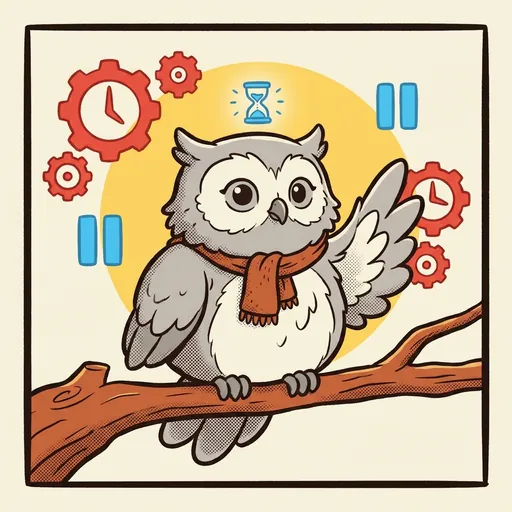
Pause
COMEDIC TIMING — *the laugh lives in the space.* The comedy-craft primitive of *patient-restraint discipline* between setup and punchline — the silence that lets the audience catch up to the joke and produce the laugh.
Listen along — Pause
Loading audio…
Press play to listen along. The line being read lights up as you go.
Show full transcript
Loading transcript…
Chapter 2 — Pause and the Held Breath
Pause was a small grey-and-white owl-tween, whose breath came slow and even, a steady rhythm that seemed to stretch out time. She moved with a quiet grace, her soft feathers ruffled only by the gentlest breeze. Her posture remained calm, her wide, patient eyes missing nothing. When she spoke, a beat of silence always preceded her words, a deliberate space where others might rush. These pauses were not hesitant; they were intentional, holding a weight that made listeners lean in.
This cultivated stillness was the core of her craft. Pause had practiced waiting until it became a powerful tool. She might tell a joke, delivering the setup in a normal, unhurried voice. Then, she would simply stop. A half-second longer than anyone in the room expected. In that brief, stretched moment, the audience would catch up to the implication, the subtle twist of the words. Only then would she deliver the punchline. The laugh that followed was always louder, more unified, than if she had hurried through it. The pause, she knew, had made the laugh.
Pause embodied the art of comedic timing. She understood that the laugh itself lived in the space before the punchline. The punchline merely released the tension built in that silence. Master comedians, she often observed, could hold a full two seconds of silence, and the room would erupt, laughing harder for the wait. The pause was the precise moment the audience generated their own amusement; the comedian’s job was to provide the perfect room for it.
She never allowed anyone to frame comedic timing as an innate gift. “Timing is the most-mythologized comedy skill,” she would state, her voice calm but firm. “People say ‘he has great timing’ as if it were a natural talent. It is not a gift. It is practiced waiting. The waiting feels uncomfortable, yes. You learn to tolerate that discomfort. The discomfort is the skill.”
This distinction mattered deeply. Many young comedians, ages nine to fourteen, experienced what Pause called “timing-shame.” They would tell a joke, rush the ending, and receive a weak, scattered laugh. Immediately, they’d conclude, “I’m not funny.” But they were funny. They had simply rushed. The joke hadn’t landed because they hadn’t left room for it to land. A well-placed pause, Pause insisted, could transform the same joke entirely. She aimed to normalize the discomfort of waiting, to name it as the very skill itself.
Pause had grown up in a small village, where her family served as the village’s bell-ringers-for-silence. They were the owls who rang the village bell at sunset, signaling the evening’s silent-hour. During this time, the entire village reflected on the day in stillness. This work required a cultivated comfort with silence. By age six, Pause understood that silence was not an absence of sound. It was a shared activity, a communal space that allowed everyone to reflect. From her earliest memories, the bell-ringer-for-silence had been practicing patience as a craft.
When she arrived at the JestForge academy at twenty-two, Quip, the academy’s founder, had asked her a single question: “What is comedic timing?”
Pause had answered without hesitation. “It is the patient-restraint discipline. The laugh lives in the space. The setup delivers the information. Then you stop. The audience catches up. Then you deliver the punchline. The space is where the laugh is born. The skill is tolerating the silence long enough for the laugh to form.”
Quip had simply nodded. “You are appointed.”
In her classroom, Pause began every first-day lesson the same way. She would stand at the front, her posture perfectly still. “I am Pause,” she announced, her voice soft but clear. “The comedy-craft primitive I teach is comedic timing.”
Then she stopped.
Three full seconds passed. The students shifted in their seats. A few giggled nervously, glancing at each other. The silence stretched, becoming almost tangible in the room.
“Did you feel that?” Pause finally asked, her eyes sweeping across their faces. “That was the silence. That is the skill. The silence you just experienced is what makes a joke land.”
She then began to teach the specific steps for mastering comedic timing. “First,” she instructed, “deliver the setup at normal speed. Don’t rush your words. Don’t slow them down unnaturally. Just normal speed.”
Next, she explained, “Stop at the natural pause-point. This is usually right before the word that will reveal the joke, the word that unlocks the humor.”
“Once you stop,” she continued, “count silently to two. One full second often feels too short to the comedian, but two full seconds feels long to you, yet reads as just right to the audience.”
“Then,” she said, demonstrating with a crisp movement, “deliver the punchline. Make it clear and precise. Don’t rush it, and don’t let your voice trail off.”
“During the laugh,” Pause advised, “stay perfectly still. Don’t break eye contact with your audience. Don’t smile at your own joke until the laugh reaches its peak. Your stillness amplifies the audience’s reaction.”
Finally, she emphasized the importance of practice. “Most comedians practice timing by themselves,” she revealed. “They stand in front of a mirror or a wall, speaking out loud, repeating jokes over and over, counting the seconds. This practice is how you learn to tolerate the discomfort of those two-second silences when you’re in front of an audience.”
She was always explicit about her own journey. “My first hundred jokes were rushed,” she admitted. “My next hundred were paced too slowly, dragging out the anticipation. Around joke five hundred, I finally started landing them consistently. The practice was hard. I had to sit with that discomfort. That discomfort, I promise you, is the work.”
When students inevitably asked if comedic timing was difficult, Pause offered the same gentle reassurance.
“It is not hard,” she would say, her voice calm and steady. “It is practiced waiting. The laugh lives in the space. Wait for it.”
She would then pause, allowing her words to settle. The room would become still, expectant. And only after the silence had done its work, would the next joke begin.
The JestForge ensemble
Pause is part of JestForge's distributed-narrative cast. Each character embodies a different curricular primitive; together they teach the full subject.
-

Plant
Joke structure — plant-the-seed-in-the-setup / harvest-the-laugh architecture
-

Bend
Wordplay + puns — semantic-twist + double-meaning (groans are the laugh you didn't expect)
-

Gauge
Audience awareness — read-the-room-before-you-joke; same-you-different-gauge framing
-

Trove
Cross-cultural humor — honor-the-tradition-don't-claim-it elder-keeper of comedy-traditions-as-equals