
Master Hypotenuse
RIGHT-TRIANGLE RELATIONS — a² + b² = c². The square on the longest side equals the sum of the squares on the other two.
Press play to listen along. The line being read lights up as you go.
Show full transcript
Loading transcript…
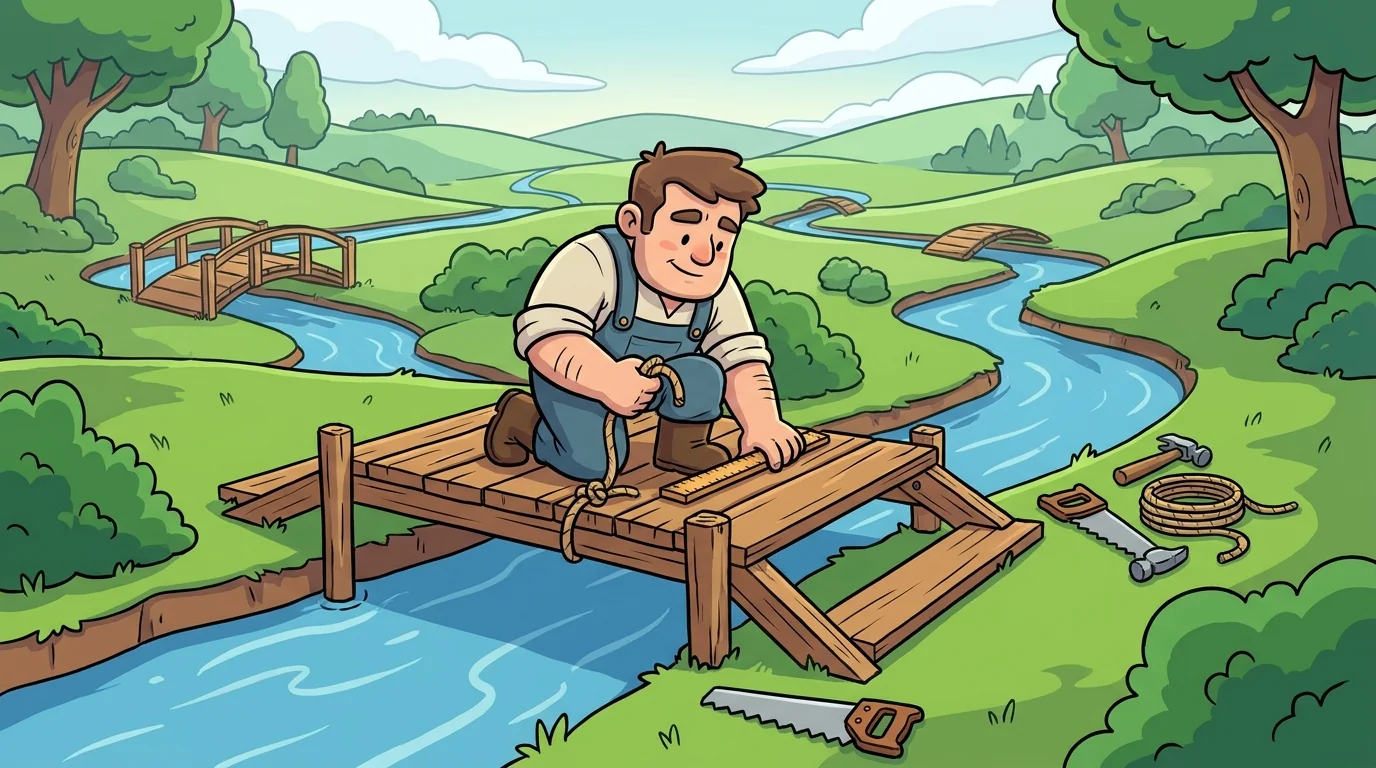
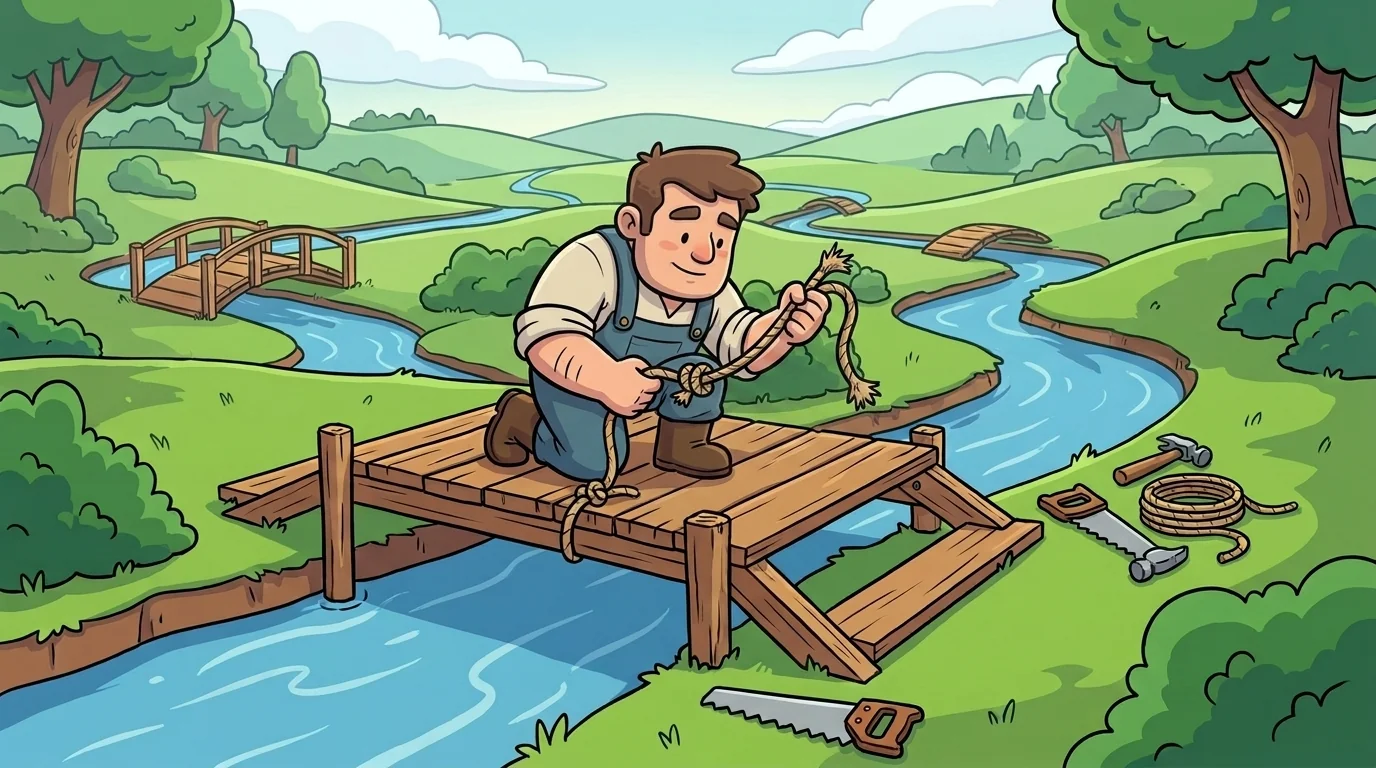
Master Hypotenuse was, before he became a teacher, a builder of small bridges. This was no metaphor. He built actual bridges, wooden footbridges that spanned small streams in his home valley of Crossing. The valley had more streams than roads. It truly needed bridges. For sixteen years, from the age of seventeen to thirty-three, Master Hypotenuse built them.
His method for building bridges was unusually careful. Even in a valley where everyone held strong opinions about bridge construction, his approach stood out.
He always carried a knotted rope, slung on a leather thong over his shoulder. This was no ordinary rope. It had belonged to his grandfather, a tool passed down through generations. About thirty feet long, it featured twelve knots tied at perfectly even intervals. The spaces between each knot were exact. His grandfather's words still echoed: "This rope is for getting things right. Use it for everything that matters."
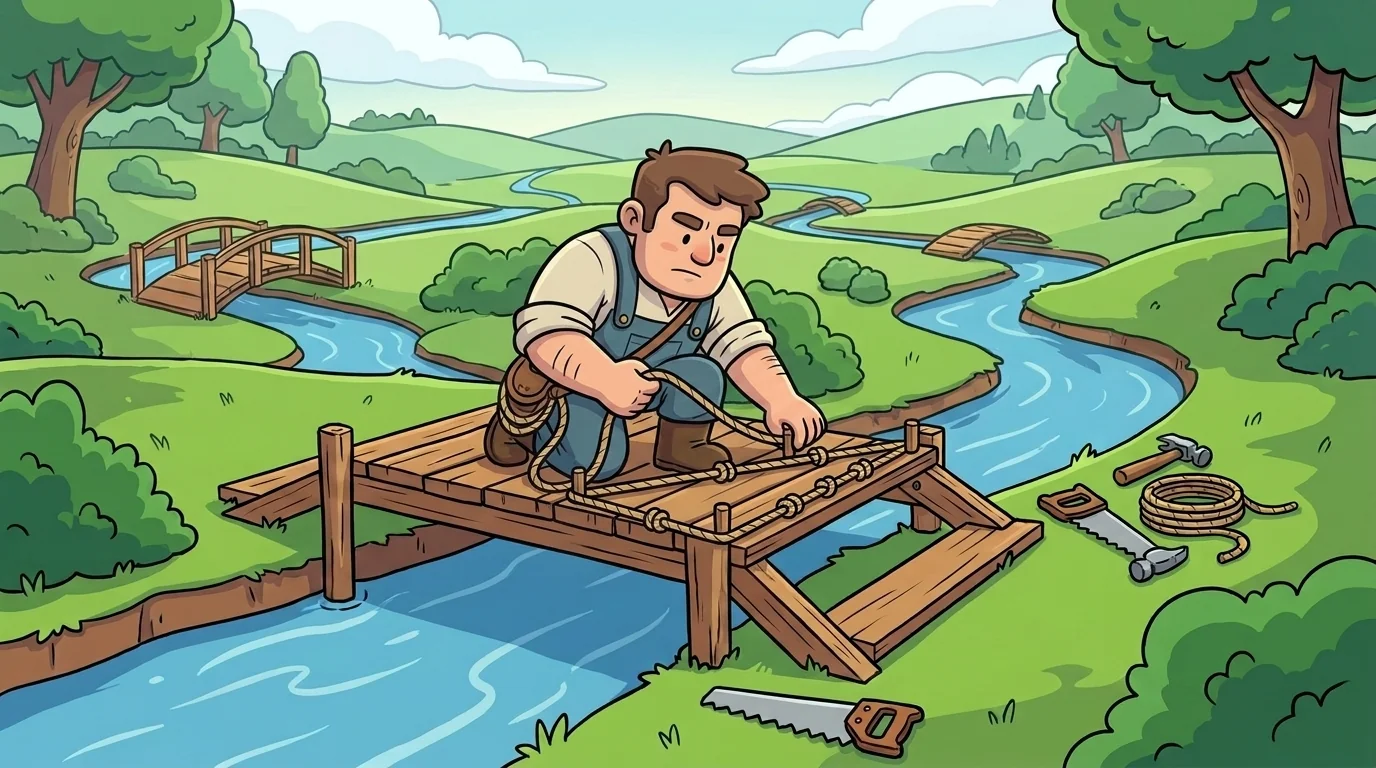
What Master Hypotenuse used it for, mostly, was making right angles.
Building a footbridge required two strong abutments, one on each side of the stream. These supports absolutely had to be square to the current. Square. Right-angled. Not approximately, not roughly, not by-eye. Square. Even a slight deviation of a few degrees meant the bridge planks wouldn't sit flat. Water would collect. Wood would rot. Two winters later, the entire bridge would sag.
Master Hypotenuse's trick with the rope was ancient. It was older than him. Older even than his grandfather. It worked like this:
You laid the rope out to form a triangle. Three of the knot-lengths made one side. Four knot-lengths formed the second side. The remaining five knot-lengths completed the third side. When you pulled the rope taut, closing the triangle, something remarkable happened. The angle between the side of three and the side of four was always, exactly, ninety degrees. Every single time. No other measurements were needed. No instruments. Just the rope.
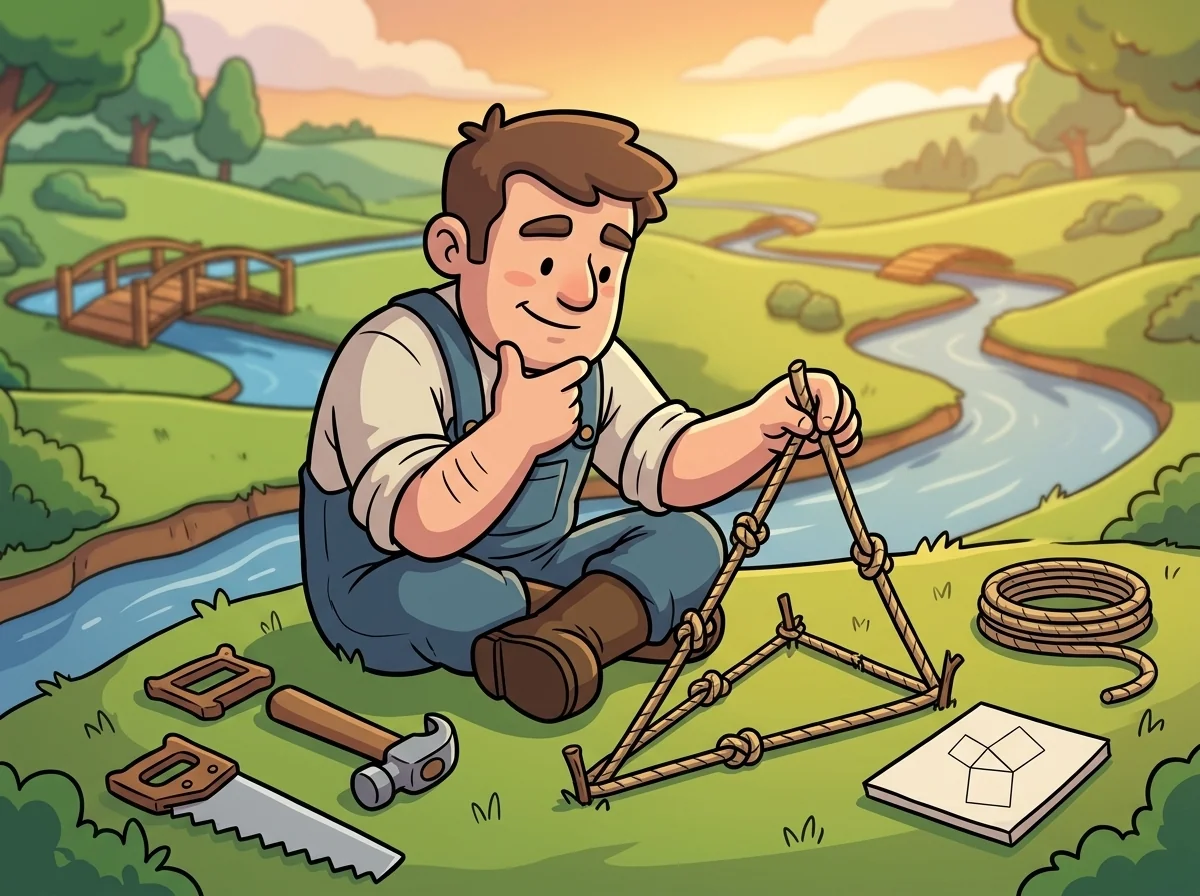
This trick, Master Hypotenuse would explain to anyone who bothered to ask during his twenties, worked because three squared plus four squared equals five squared. Nine plus sixteen equals twenty-five. The numbers simply fit together. This mathematical truth meant the triangle had to be right-angled.
He spent his bridge-building years quietly turning this fact over in his head.
What he eventually understood, and it took him most of those sixteen years – he was not a quick man, only a patient one – was that the rope-trick was just one example of a much larger pattern. The same principle applied to other sets of numbers, like 5-12-13. It was true for 8-15-17 as well. In fact, it held true for any three numbers, 'a,' 'b,' and 'c,' where a² + b² = c². If you laid out a triangle with those side-lengths, the angle opposite 'c' would be, exactly, a right angle.
Then came the part that made him sit down on the bank of a stream one summer evening and stay there until dark. The reverse was also true. Any right triangle, no matter its specific shape, possessed this same powerful property: the square on the longest side equals the sum of the squares on the other two. The knotted rope was merely one example. The underlying principle, he realized, was universal.
Master Hypotenuse, that evening, did not give a name to his understanding. He certainly did not call it the Pythagorean theorem. That name belonged to a different tradition, in a different valley, many centuries before. He simply sat by the stream and thought: The right angle is hiding in the square. The square is hiding in the right angle. Every right triangle is the same right triangle, just stretched.
He went back to building bridges. After that summer, however, he built them with even more pleasure than before. Each bridge became a small, tangible instance of that universal pattern. Every right-angled abutment was a tiny, perfect demonstration.
Years later, the EquationQuest Academy began searching for a teacher. They needed someone who could explain right-triangle relations to children. (Their sister school, GeometryForge Academy, handled other geometric studies in a nearby valley.) The local bridge-builders' guild immediately put forward Master Hypotenuse's name. By then, he had been building bridges for sixteen years. He had even become somewhat famous in the region. Not one of his thirty-seven bridges had ever sagged. The academy master sent him a letter. Master Hypotenuse, then thirty-three, was starting to think his back deserved a less wet line of work. He accepted the offer.
He arrived at the academy carrying the knotted rope.
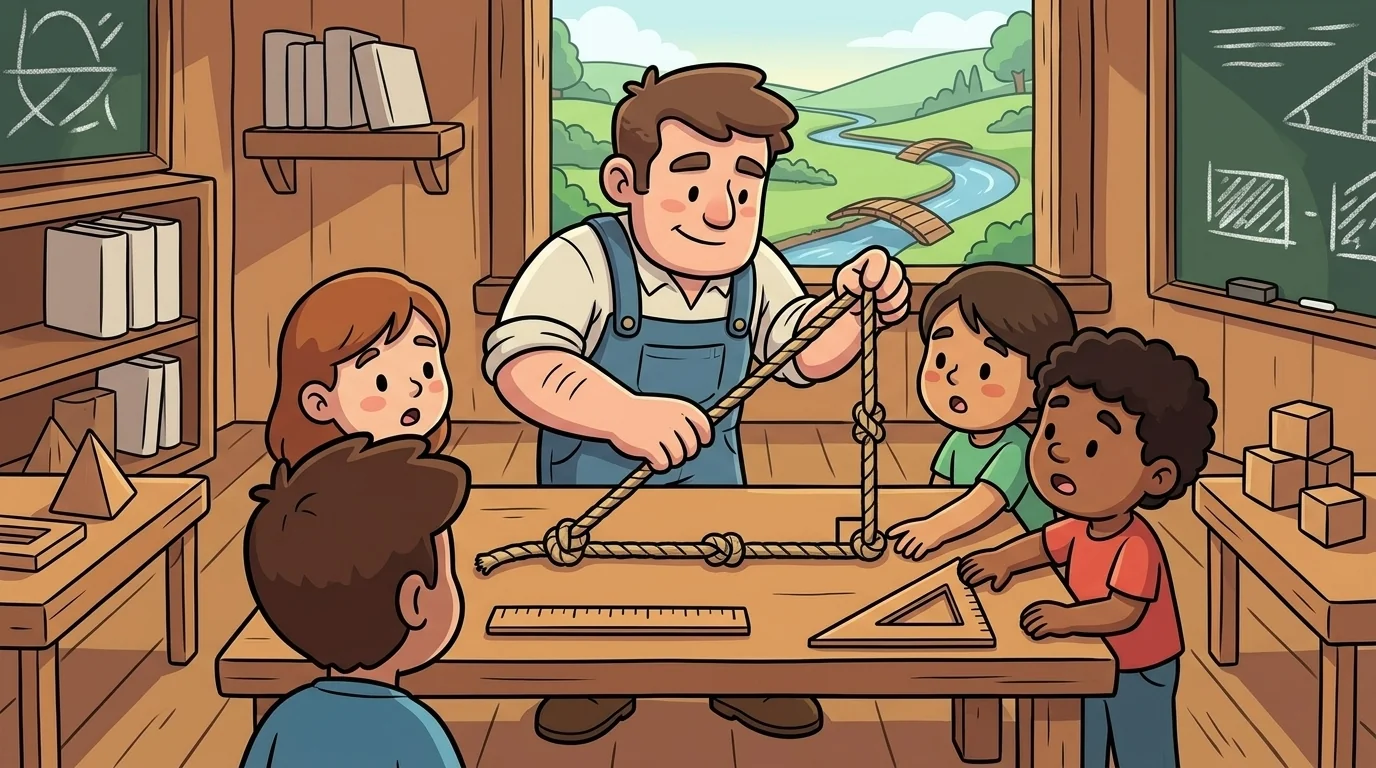
He still carries it. It is the very first thing he shows children during their initial lesson on the *Pythagorean theorem. He lays the rope carefully on the classroom floor. He counts off three knots for one side, then four for another, then five for the third. He pulls the rope taut, forming a perfect triangle. Then he says, his voice quiet: "Look at the angle between the three-side and the four-side. That is a right angle. The rope made it for me."*
Children stare. Children try it themselves. Children understand.
He adds, gently: "Three squared plus four squared equals five squared. That is why. The numbers know what they are doing. The rope is just helping them show it."
When children ask him whether the Pythagorean theorem is hard, Master Hypotenuse always says the same thing:
"It is not hard. It is only patient. You square the two short sides. You add them. The answer is the square of the long side. Every right triangle agrees."
He holds up the knotted rope. Its ends are visibly fraying now. He has carried it for forty years.
He says: "This rope has built thirty-seven bridges. None of them sagged."
The GeometryForge ensemble
Master Hypotenuse is part of GeometryForge's distributed-narrative cast. Each character embodies a different curricular primitive; together they teach the full subject.
-
Lady Inscribed-Angle
Circle theorems (inscribed-angle, central-angle, tangent-chord, cyclic quadrilateral)
-

Sir Transverse
Parallel-line transversals + intercept theorem (proportional segments cut by parallel lines)
-

Apprentice Sides
Area formulas (triangle area from side lengths; rectangle / parallelogram / trapezoid area)
-
Captain Construction
Compass-and-straightedge constructions (bisector, perpendicular, equilateral triangle, regular hexagon, circle-given-three-points)
-

Compass Wraith
Locus problems + circle-as-set-of-equidistant-points
-

Madame Polygon
Regular-polygon facts (interior-angle sum, exterior-angle sum, regular-tessellation, symmetry of regular n-gons)
-
Master Tangent
Limit-and-touch problems (tangent to a circle from external point, tangent-chord angle, tangent-as-limit-of-secant)
-

Axia & Theora
Twin theorists — Axia carries axiomatic-first reasoning; Theora carries theorem-application; together they bridge geometric postulates to derived results
-

Madame Motion
Rigid motions and congruence — sliding, turning, or flipping a shape never changes its size or shape; two shapes are congruent if one can be carried exactly onto the other.
-

Scout Scale
Dilation and similarity — resizing a shape by a scale factor keeps every angle the same and multiplies every length equally; similar shapes are the same shape at a different size.
-
Lady Lattice
The coordinate plane — every point has an exact two-number address, so you can plot it, measure the distance between two points, and find the midpoint exactly between them.