
Captain Construction
COMPASS-AND-STRAIGHTEDGE CONSTRUCTIONS — bisector, perpendicular, equilateral triangle, regular hexagon, circle-given-three-points. Geometry built with only two tools, never measuring with a ruler.
Press play to listen along. The line being read lights up as you go.
Show full transcript
Loading transcript…
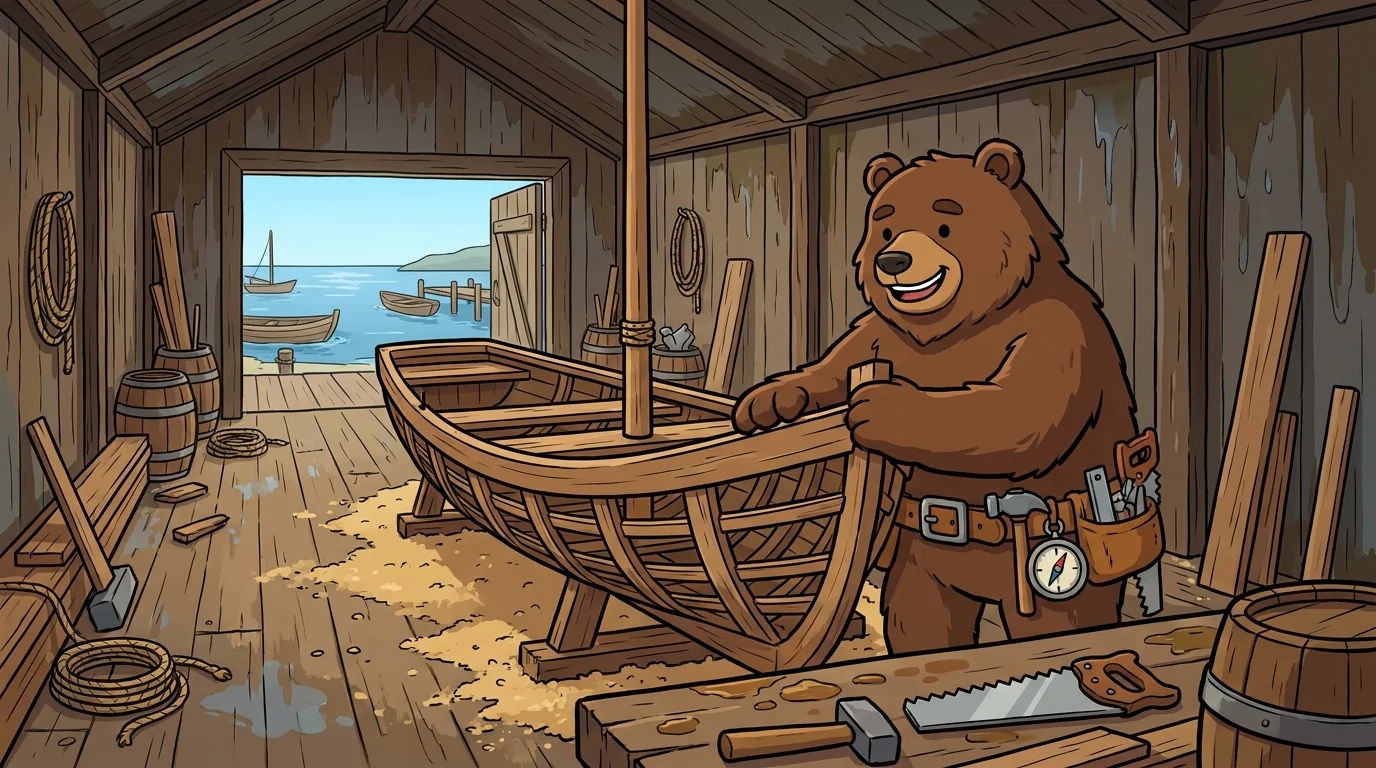
For twenty-two years, Captain Construction was a shipwright. His hands knew the grain of every timber, the curve of every plank. He built sturdy wooden vessels in the bustling coastal town of Hull Bay, a place where the salty air always carried the scent of fish and tar. Most of his creations were fishing boats: single-mast, single-sail, single-hull, perfectly suited for two or three fishermen and a morning’s abundant catch. He crafted them with patient care in a long, weathered wooden shed at the head of the bay. The shed perpetually smelled of pine resin and the rich, earthy tang of rope-oil. Sawdust coated the floor like a soft, golden snow, and the rough-hewn walls always felt cool and damp to the touch.
Captain Construction — whose birth name was Bram, though everyone had called him Captain since he was nineteen — was a formidable figure. He had never once captained a boat in his life; the title was merely a workshop nickname that had stubbornly stuck. Bram was a bear-headed shipwright, his arms thick with brown fur, his shoulders broad and powerful from years of hauling timber. He wore a leather toolbelt that, even by the generous standards of shipwrights, was stuffed with more tools than it strictly needed. It jingled and clanked with every movement, a symphony of metal and leather.
Yet, when Bram laid out the crucial curves of a hull, he reached for only two of those many tools.
A compass.
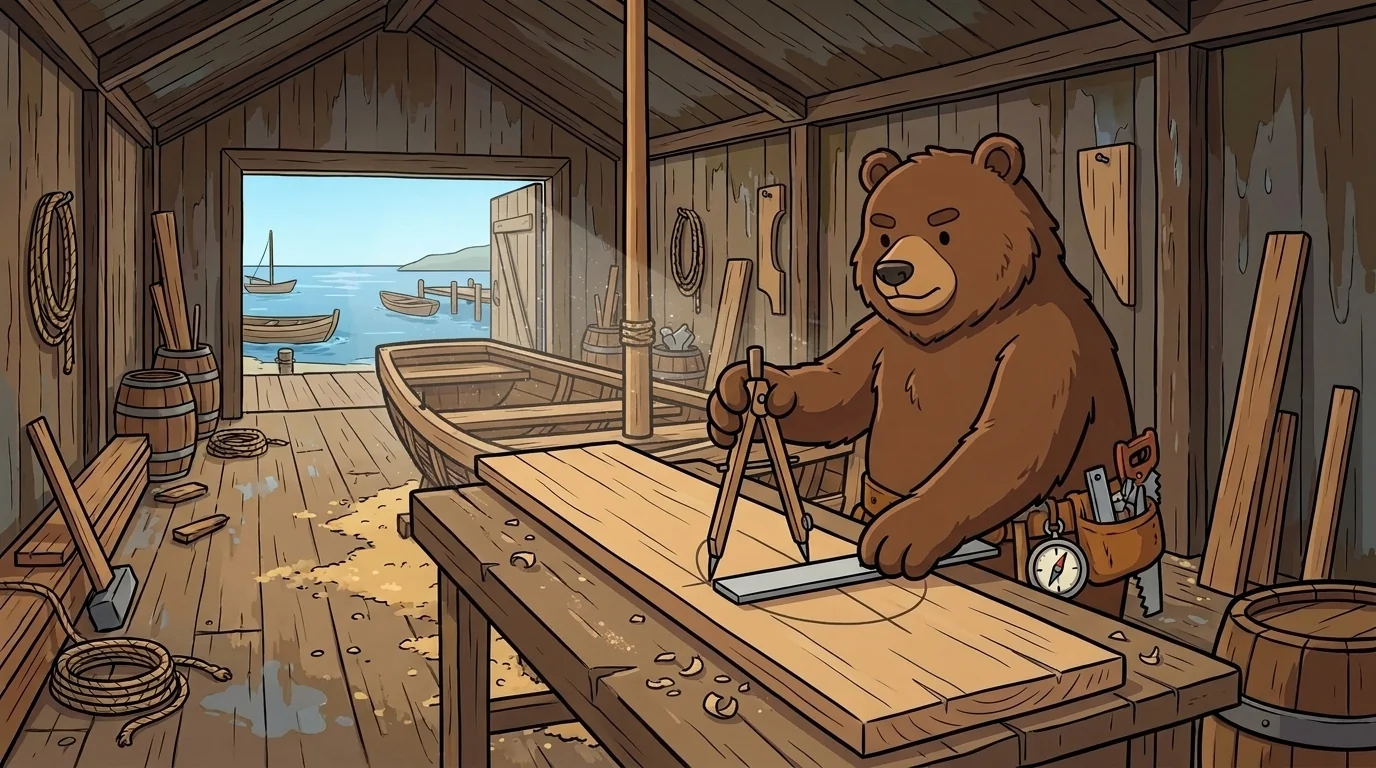
And a straightedge.
To the other shipwrights in Hull Bay, this approach seemed utterly absurd. They watched him, scratching their heads, their expressions a mix of bafflement and mild scorn.
Other shipwrights relied on familiar, time-honored methods. They used wooden rulers, marked meticulously in thumbs and palms and forearm-lengths. They worked with measuring-sticks, worn smooth from countless uses. Many even employed templates, carefully copied from the ones their fathers had used, passed down through generations like treasured heirlooms. They would pencil rough distances onto the wood, measure them with painstaking accuracy, mark them with a sharp awl, and then proceed to saw. It was a practical, if imperfect, way of working.
Bram, however, simply refused. He considered their methods deeply flawed.
"A ruler is a lie waiting to happen," he would growl, his voice a deep, bear-rumbly sound, whenever someone dared to question his peculiar habits. He spoke with the conviction of a man who had seen the truth revealed. "The marks on a ruler wear off, you see. The wood itself swells and shrinks with the changing seasons. Those marks shift. A measurement made with a ruler can be off by half a thumb, and you might never even know it. But a construction made with a compass-and-straightedge? That is the same construction, every single time. The compass arc does not care if the wood has swelled. The straightedge does not care if the chalk has worn thin. The construction is the geometry. And the geometry, my friends, is the boat."
For Bram, this wasn't just a technique; it was an article of unwavering faith. It was a philosophy he lived by, a truth as solid as the oak keels he laid.

He had learned this precise method from his own father, who in turn had learned it from his grandfather. The family lore claimed that the tradition originated with a legendary shipwright in the next valley over, a man famous for never losing a single boat to a structural fault. The *compass-and-straightedge construction* tradition was, in Bram’s family, a legacy spanning three generations, a quiet rebellion against the quick and easy.
He dedicated twenty-two years to building boats this way. Every single curve he laid was a perfect compass-arc, smooth and unbroken. He found every right angle by constructing a perpendicular line from a chosen point, never by simply measuring with a carpenter’s square. He divided every spar into precise halves and thirds by constructing bisectors and trisectors, never by counting thumb-widths along the timber. The work was undeniably slower. It demanded an almost obsessive level of care. But the work, Bram knew deep in his bones, was correct. It was exact.
Over those twenty-two years, he built one hundred and forty-six boats. Each one a testament to his meticulous method.
And in all that time, not one of his boats ever sank. Not a single one succumbed to structural failure, not a single one broke apart in a storm.
This was, and still remains, truly unusual. The typical rate for fishing boats in Hull Bay was that roughly one in every twenty would suffer some kind of structural issue within five years of launch. Bram’s boats, however, defied these odds. They simply did not fail. The harbour-master, a grizzled old sea dog who had watched Bram work for three decades, eventually arrived at a profound conclusion: the geometry was right. Other shipwrights built boats that worked, yes. But Bram built boats that had to work. Every curve had been derived from a single, fundamental principle. Every angle had been meticulously constructed, not merely measured. Every dimension was the logical, undeniable consequence of every other dimension. His boats were not just assembled from a collection of parts; they were constructed from a small, elegant set of axioms, like a floating mathematical proof.
When the GeometryForge academy began its search for someone to teach *compass-and-straightedge construction to children, the academy master heard about Bram from a sea captain. This captain, a man who had sailed Bram’s boats through countless gales, put it simply: "He does not build boats. He builds proofs that happen to float."*

The academy master, intrigued by such a glowing and peculiar recommendation, wrote Bram a letter. Bram, then forty-one, felt the familiar ache in his bear-shoulders and knew they might not endure another decade of bending over hulls. He accepted the offer, a new chapter beginning.
He brought his trusty compass and his straightedge with him to the academy. He still possesses both, their surfaces worn smooth by years of use. He affectionately calls the compass the swing-arm, explaining that it swings around its center point much like a sturdy gate swings around its hinge. It’s a simple, elegant description.
In his classroom, the very first lesson is always the same, a ritual of introduction to a new way of seeing. He carefully sets out, on every child’s desk, a compass and a straightedge. Then he speaks, his bear-rumble filling the quiet room: "Today, we are not going to measure anything. We are going to construct everything. The compass first. The straightedge second. No measuring. That’s the deal."
The children, without fail, always protest. Their young faces scrunch in confusion. They ask how they could possibly draw anything accurate, anything precise, without the familiar comfort of a ruler or a protractor. It seems impossible.
Captain Construction just smiles. Bear-headed smiles are slow and gradual, like the sun rising over the bay, but they are undeniably warm. He looks at each child in turn, his eyes twinkling. He says: "You will see. The geometry will tell you what to do. The compass will tell you how far. The straightedge will tell you which way."
He then demonstrates the first construction: bisecting an angle. He moves with a practiced ease, his large hands surprisingly delicate as he guides the tools. The method itself is older than the kingdom, older even than Bram’s grandfather. It requires no ruler, no measurement. Yet, the method yields an angle bisector that is, exactly, a bisector. It is a line of perfect division.

The children try it themselves, following his precise movements. Their brows furrow in concentration. They watch, amazed, as their lines split the angles perfectly. They check their work with protractors (the academy keeps them for verification, a tool Bram tolerates with a grudging, almost imperceptible nod). The bisector is exactly half of the original angle. Every single time. There is no error, no approximation.
Captain Construction nods, a slow, satisfied movement. He says: "This is geometry. The compass and the straightedge are the only tools you need. Everything else follows from these. Everything."
He adds, his voice dropping to a deeper bear-rumble, a hint of pride in his tone: "Also: my boats did not sink. The geometry, in case you are wondering, was exactly the same as this. Just bigger."
When children ask whether *compass-and-straightedge construction* is hard, Captain Construction always offers the same reassuring reply. He looks at their eager, sometimes uncertain faces.
"It is not hard," he says. "It is only patient. Compass first. Straightedge second. No measuring. The geometry tells you what to do. Trust the geometry."
He still keeps the compass on his belt, a constant companion. The children sometimes ask to hold it, drawn to its weight and history. He always lets them, watching as they trace imaginary arcs in the air, a new generation learning to trust the silent language of lines and curves.
The GeometryForge ensemble
Captain Construction is part of GeometryForge's distributed-narrative cast. Each character embodies a different curricular primitive; together they teach the full subject.
-

Master Hypotenuse
Right-triangle relations: a² + b² = c²
-

Lady Inscribed-Angle
Circle theorems (inscribed-angle, central-angle, tangent-chord, cyclic quadrilateral)
-

Sir Transverse
Parallel-line transversals + intercept theorem (proportional segments cut by parallel lines)
-

Apprentice Sides
Area formulas (triangle area from side lengths; rectangle / parallelogram / trapezoid area)
-

Compass Wraith
Locus problems + circle-as-set-of-equidistant-points
-

Madame Polygon
Regular-polygon facts (interior-angle sum, exterior-angle sum, regular-tessellation, symmetry of regular n-gons)
-
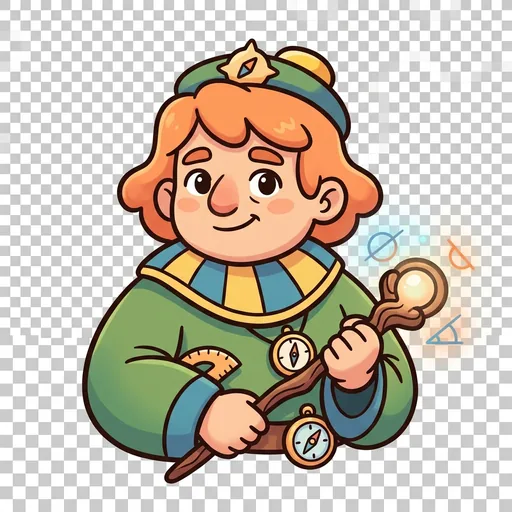
Master Tangent
Limit-and-touch problems (tangent to a circle from external point, tangent-chord angle, tangent-as-limit-of-secant)
-

Axia & Theora
Twin theorists — Axia carries axiomatic-first reasoning; Theora carries theorem-application; together they bridge geometric postulates to derived results
-

Madame Motion
Rigid motions and congruence — sliding, turning, or flipping a shape never changes its size or shape; two shapes are congruent if one can be carried exactly onto the other.
-

Scout Scale
Dilation and similarity — resizing a shape by a scale factor keeps every angle the same and multiplies every length equally; similar shapes are the same shape at a different size.
-
Lady Lattice
The coordinate plane — every point has an exact two-number address, so you can plot it, measure the distance between two points, and find the midpoint exactly between them.