
Apprentice Sides
AREA FROM SIDES — the area of a triangle can be computed from its three side-lengths alone (Heron's formula: s = (a+b+c)/2, area = √(s(s−a)(s−b)(s−c))). The principle: you do not need the height.
Press play to listen along. The line being read lights up as you go.
Show full transcript
Loading transcript…
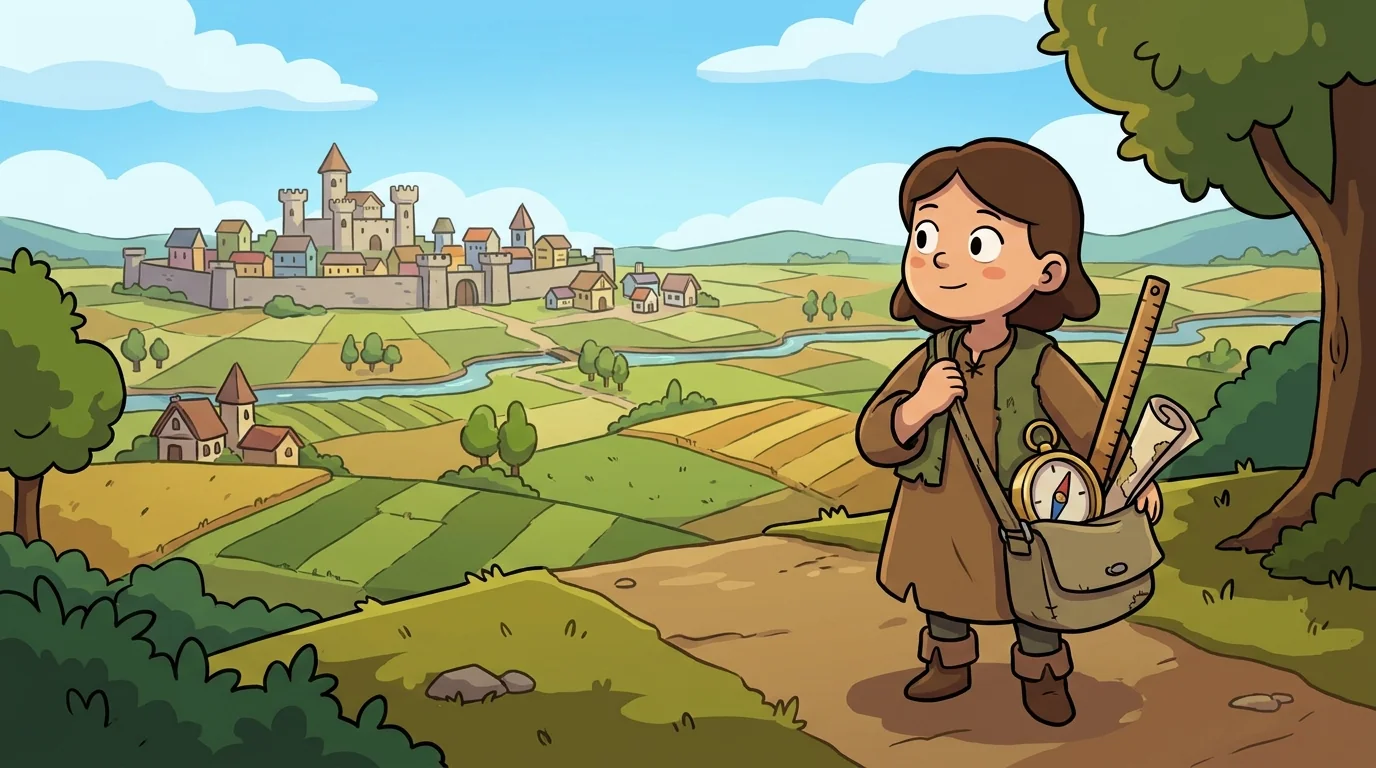
Bryn was twelve when her family formally bound her to a master craftsperson, making her an apprentice. This age was common throughout the kingdom. Children of twelve were considered old enough to follow a seasoned worker, to carry their tools, and observe their intricate work. They gradually picked up a trade by what everyone called long imitation. Apprenticeships lasted seven years, a fixed span of time. By nineteen, you were a journeyman, free to travel and work for hire. By twenty-five, if your skill was truly exceptional, you could become a master in your own right.
Apprentice Sides — whose given name was Bryn, though most people, including Bryn herself on busy days, had forgotten it — was apprenticed to a surveyor named Old Hardridge. Bryn was a hedgehog-child, her spine-tufts a soft, dark brown, usually hidden beneath her practical, chalk-dusted apron.
Old Hardridge was, by all accounts, an unusual surveyor. He worked alone most of the time. He took on apprentices reluctantly, often muttering about the nuisance of young minds. He measured fields with the same precision as other surveyors, carefully marking boundaries and angles. However, he refused—adamantly refused—to measure one specific thing.
Heights.
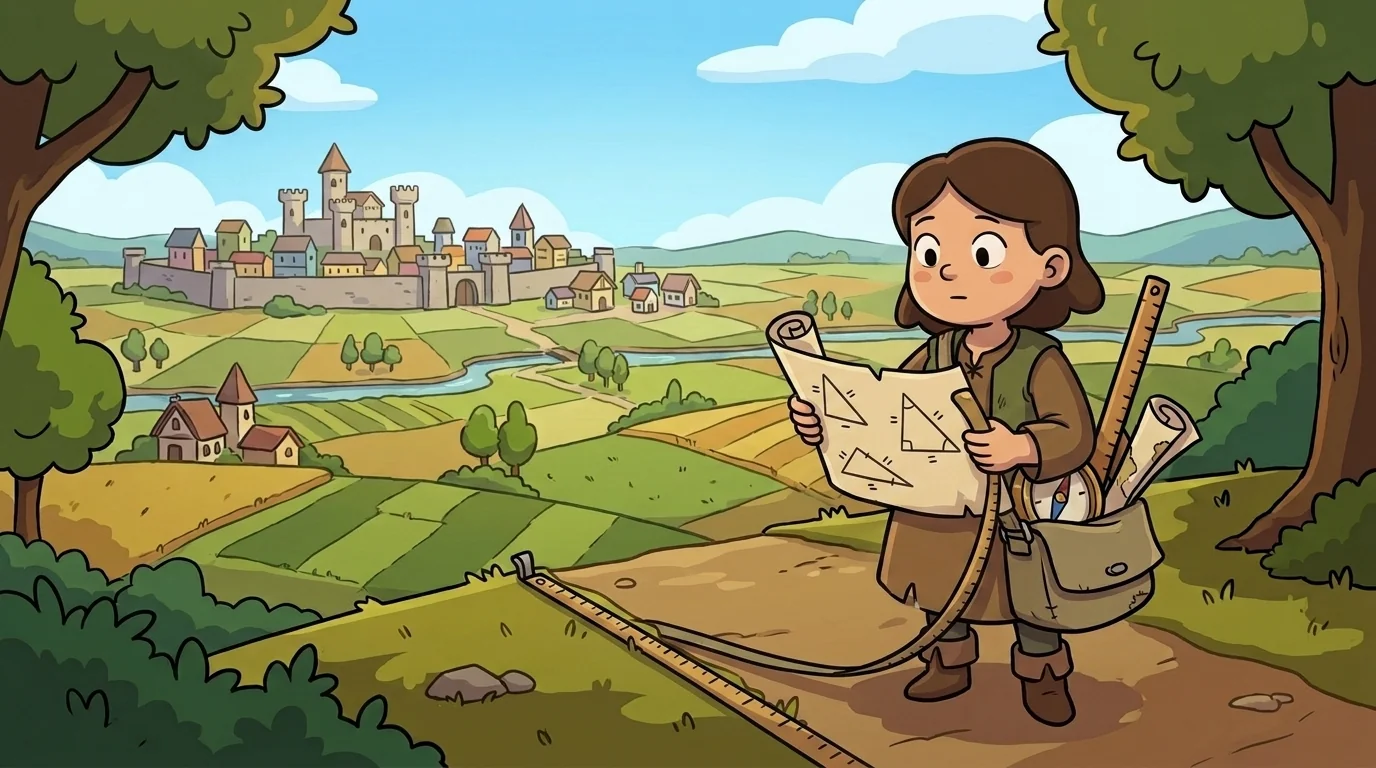
This had a very particular meaning in the surveying trade. When you measured a field, especially one shaped like a triangle, you first marked its boundaries. These were the sides. To calculate the area of that triangle, the standard method involved choosing one side as the base. Then, you would drop an imaginary perpendicular line from the opposite corner down to that base. This imaginary line was the *height*. You then multiplied the base by the height and divided the result by two. Every surveyor learned this method. It was fundamental to their craft.
Old Hardridge simply refused.
"Heights are a lie," he would grumble to Bryn, his voice like stones tumbling in a dry riverbed. He said this the first hundred times she dared to ask him why. "The sides are what you can stand on. The sides are what you can walk along. The sides are real. The height is what you have to calculate by dropping an imaginary line through the air. The air does not hold a measurement. The sides do."
Bryn was twelve and still very new to the world. She did not understand his reasoning at first. She just thought Old Hardridge was being grumpy. He was being grumpy, of course. That was typical of him. But his grumpiness was not the only thing he was being.
What Bryn eventually understood, slowly, over the course of her apprenticeship, was that Old Hardridge possessed a unique method. It was a way of working that most other surveyors had forgotten, or perhaps never even learned. This method calculated the area of a triangle using only the lengths of its three sides. It required no imaginary lines, no perpendicular drops, no heights at all.

Old Hardridge called his method the three-sides trick. He taught it to Bryn the way he taught everything else: slowly, patiently, and repeatedly. He would use his gravelly voice, a small chalk slate, and a tiny clay model of a triangle. The trick went like this:
> Take the three sides. Name them a, b, and c. Add them together and divide the sum by two. Call that result s, the half-perimeter. Then, to find the area, you take the square root of s multiplied by (s minus a), multiplied by (s minus b), multiplied by (s minus c). It works every time. For every triangle. No height needed.
Bryn was fifteen when she finally believed him. She had spent three years listening to his lectures, practicing the formula, and still feeling a deep, nagging doubt. One afternoon, Old Hardridge sent her to measure a triangular field near the village mill. She could see it was about thirty paces on its longest side. She carefully measured each side, applied the three-sides trick, and wrote down the area.
Then, out of pure stubbornness, she decided to check his work. She measured the same field the standard way, pacing out a perpendicular line from one corner to the opposite base. She found a height of about twelve paces. She multiplied the base by the height, then divided by two. The two answers agreed. Exactly.
She tried it again the next day. A different field, a different shape. The two methods agreed.
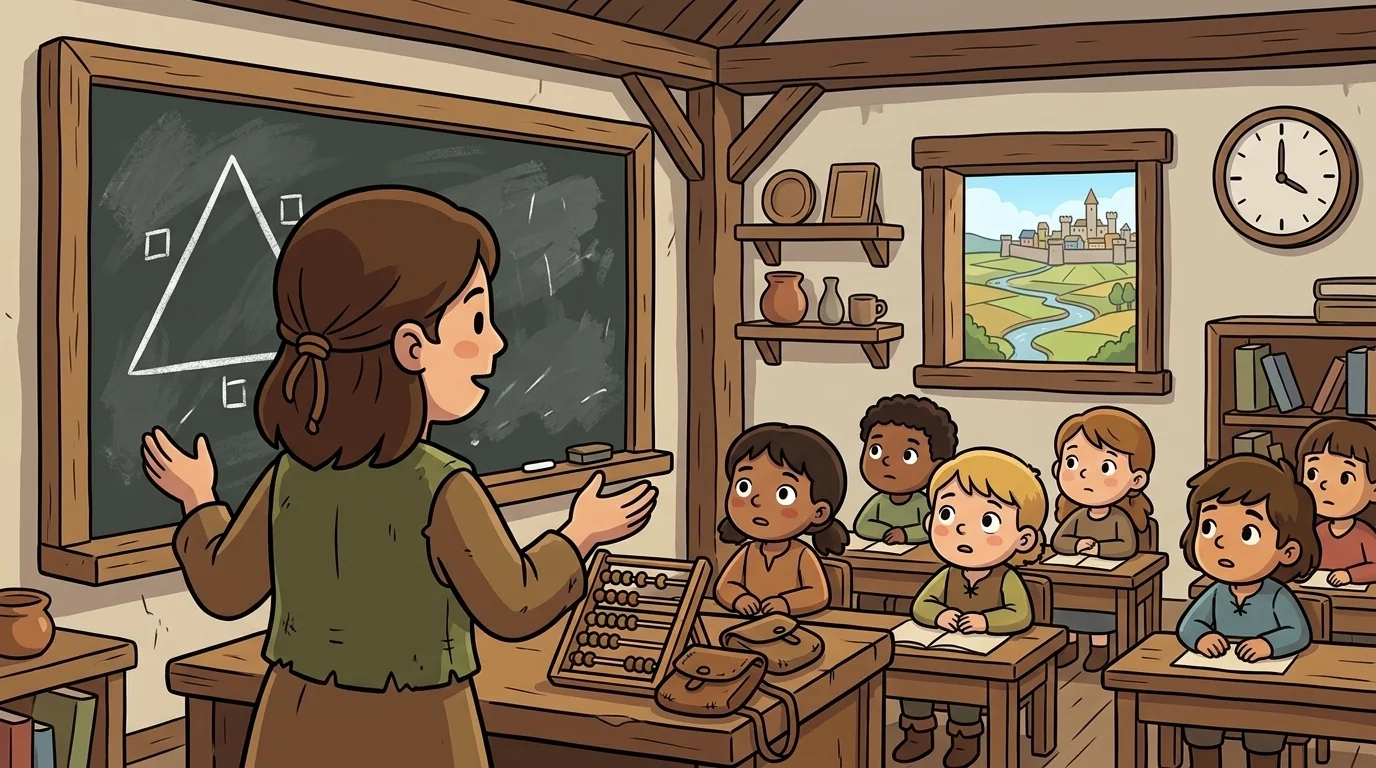
She did it a third time. And a fourth. And a fifth. Each time, the answers always matched. A quiet, profound satisfaction settled in her chest.
When she was sixteen, Bryn finally asked Old Hardridge how the trick could possibly work. How could just the sides give you the area, without ever needing to know the height?
Old Hardridge looked at her, his eyes crinkling at the corners. "The sides know where the height is," he said, his voice softer than usual. "The sides hold the height. You only think you need to drop the line. The sides are already telling you."
Bryn did not fully understand him then. She understood him much later, years after she had become a journeyman. She had even derived the formula for herself algebraically, working through equations late into the night. It turned out that the half-perimeter formula and the standard base-times-height formula were actually the same formula, just written differently. The half-perimeter version simply hid the height inside the algebra, making it unnecessary to measure directly. By then, Old Hardridge had retired and was sitting on his porch in the village. When Bryn went to visit him and told him she had finally understood, he just nodded slowly. "I told you," he said.
She kept his slate. It is the same slate she uses today, in her classroom, when she teaches children the three-sides trick. It is scratched and chipped and stained with years of chalk dust. It is the slate she learned on.
Bryn is now thirty-one. She has been teaching for six years. She is still called Apprentice—even by the academy master, even by her own students. This is because, she says, she is still learning. Old Hardridge taught her one trick. She has spent ten years finding more triangles to use it on. There are, she says, more triangles in the world than she will ever measure.
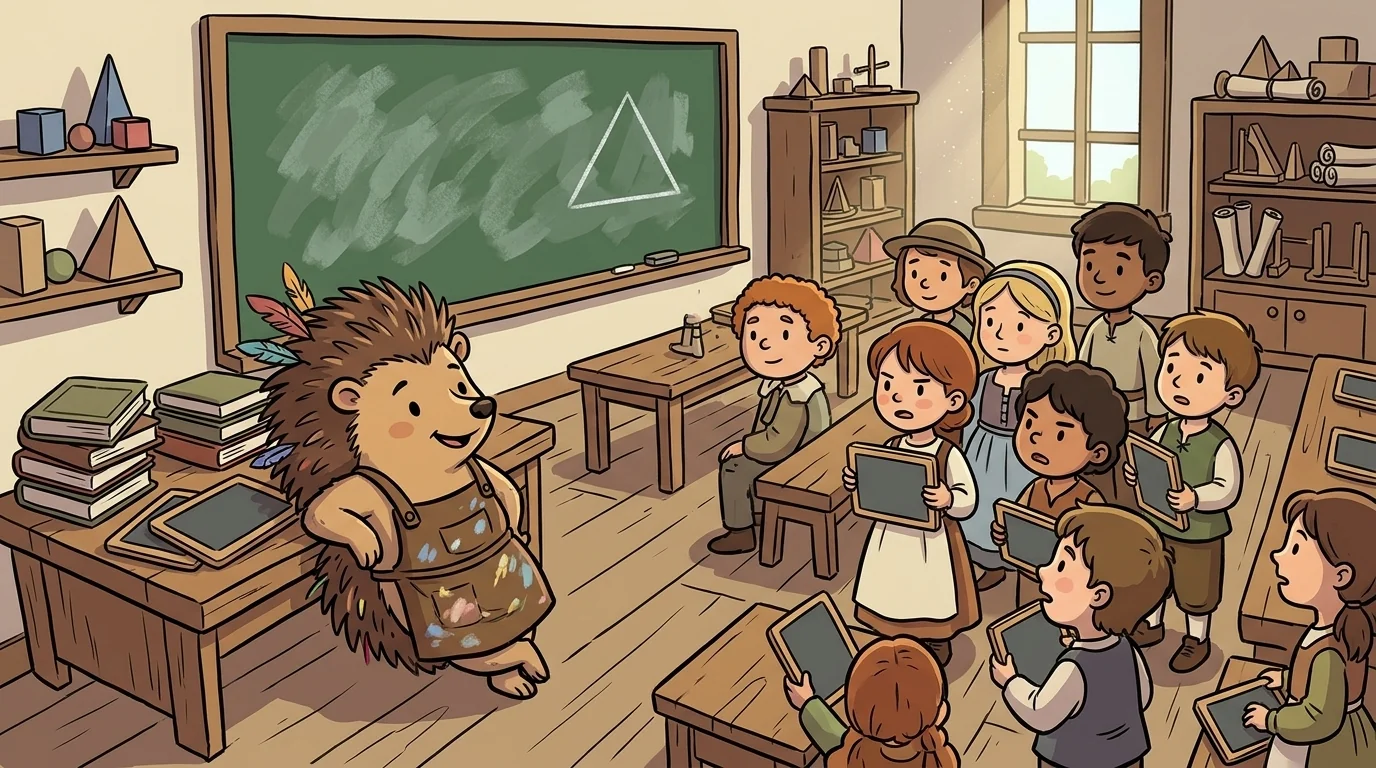
When children arrive in her classroom for the first time, she hands them a small slate and a piece of chalk. She draws a triangle on the board, her quill-feathers peeking charmingly from behind her spine-tufts. She labels the three sides: a, b, c. "Compute s," she instructs them. "Then take the square root of s times (s minus a) times (s minus b) times (s minus c). That is the area. Try it. I will not tell you the height. You do not need it."
The children—always—protest. They insist they need the height. They have been taught, since their earliest lessons, that they need the height.
Apprentice Sides smiles, her apron dusted with chalk. "Old Hardridge taught me the same protest," she says. "I made it for three years. Then I tried the trick. The trick was right. The protest was wrong."
The children, hesitant but curious, try the trick. They work through the calculations, their small chalk pieces scratching against their slates. Then they check their answer against the textbook formula, the one that uses height. The two answers agree. A murmur of surprise ripples through the room.
Apprentice Sides leans back against her desk, watching them. "The sides know where the height is," she says, her voice calm and clear. "The sides hold the height. You do not need to drop the line. The sides are already telling you."
She adds, after a moment, a small, knowing smile playing on her lips, "Old Hardridge would be very pleased that you tried it."
The GeometryForge ensemble
Apprentice Sides is part of GeometryForge's distributed-narrative cast. Each character embodies a different curricular primitive; together they teach the full subject.
-

Master Hypotenuse
Right-triangle relations: a² + b² = c²
-

Lady Inscribed-Angle
Circle theorems (inscribed-angle, central-angle, tangent-chord, cyclic quadrilateral)
-

Sir Transverse
Parallel-line transversals + intercept theorem (proportional segments cut by parallel lines)
-
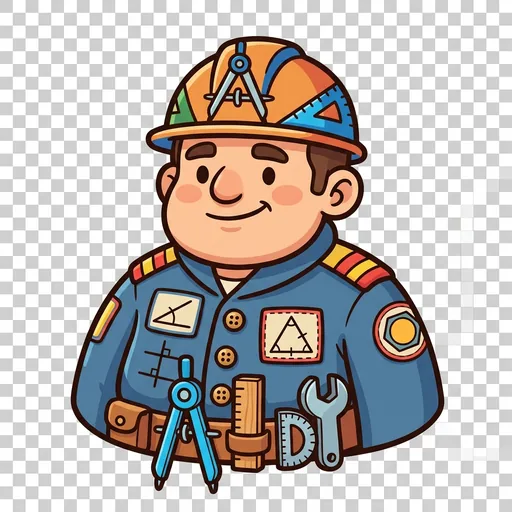
Captain Construction
Compass-and-straightedge constructions (bisector, perpendicular, equilateral triangle, regular hexagon, circle-given-three-points)
-

Compass Wraith
Locus problems + circle-as-set-of-equidistant-points
-

Madame Polygon
Regular-polygon facts (interior-angle sum, exterior-angle sum, regular-tessellation, symmetry of regular n-gons)
-
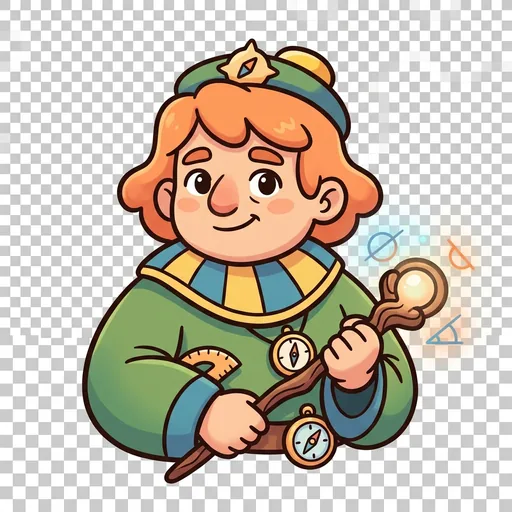
Master Tangent
Limit-and-touch problems (tangent to a circle from external point, tangent-chord angle, tangent-as-limit-of-secant)
-

Axia & Theora
Twin theorists — Axia carries axiomatic-first reasoning; Theora carries theorem-application; together they bridge geometric postulates to derived results
-

Madame Motion
Rigid motions and congruence — sliding, turning, or flipping a shape never changes its size or shape; two shapes are congruent if one can be carried exactly onto the other.
-

Scout Scale
Dilation and similarity — resizing a shape by a scale factor keeps every angle the same and multiplies every length equally; similar shapes are the same shape at a different size.
-
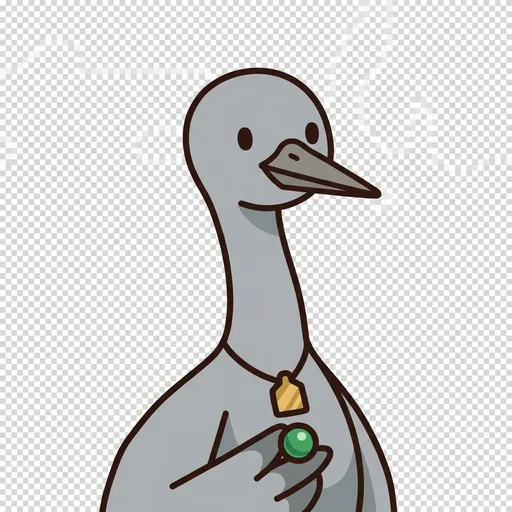
Lady Lattice
The coordinate plane — every point has an exact two-number address, so you can plot it, measure the distance between two points, and find the midpoint exactly between them.