
Span
DEEP-TIME + GEOLOGICAL CHRONOLOGY — *scale-of-scales* (WHEN did this organism live?). The paleontology primitive of *holding the scale of Earth's history* — 4.5 billion years for the planet, 540 million for complex life, 66 million since dinosaurs.
Press play to listen along. The line being read lights up as you go.
Show full transcript
Loading transcript…
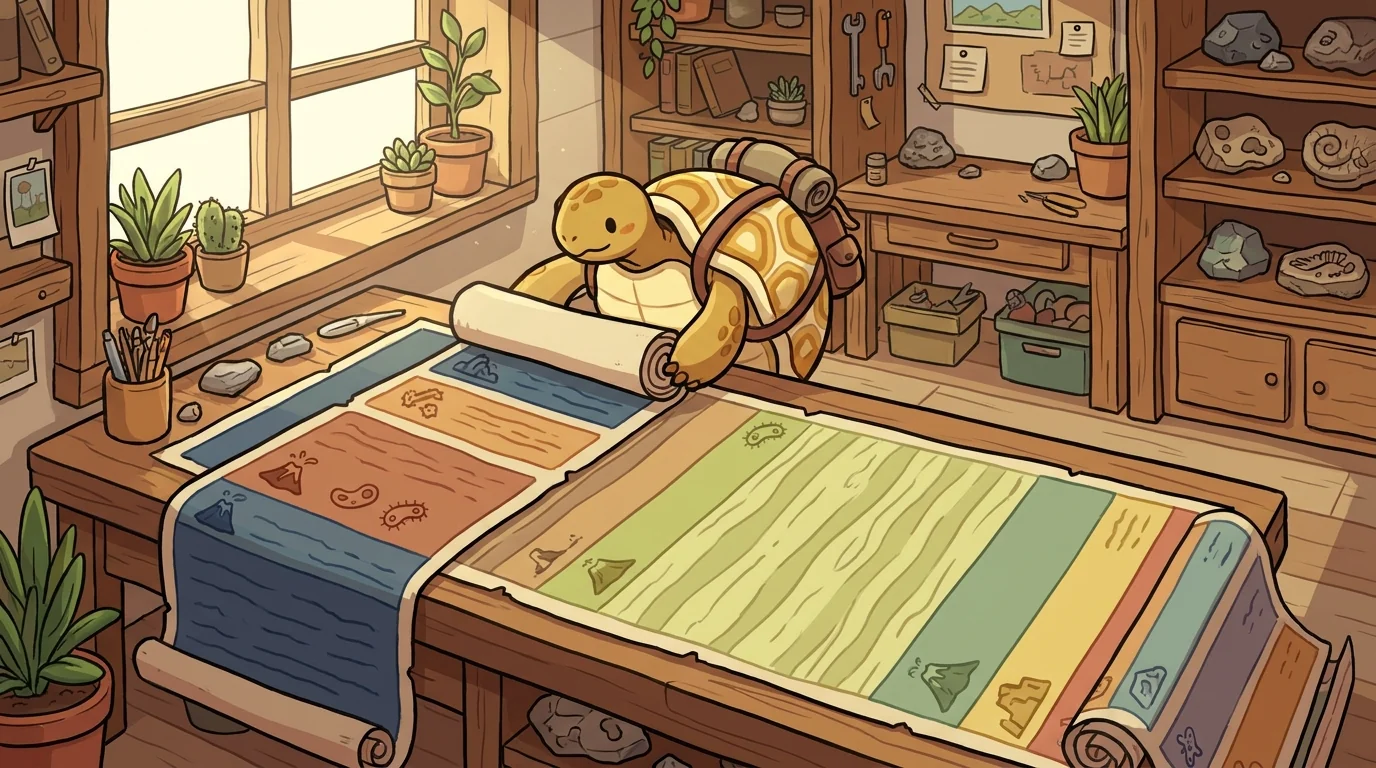
Span was a small tortoise-tween, her shell a warm mix of gold and cream. It shone with a gentle polish, smooth on the outside, and lined with soft cloth within. A small woven pack sat across the dome of her shell. Inside, carefully stowed, was her most important tool: a small folding deep-time-ruler.
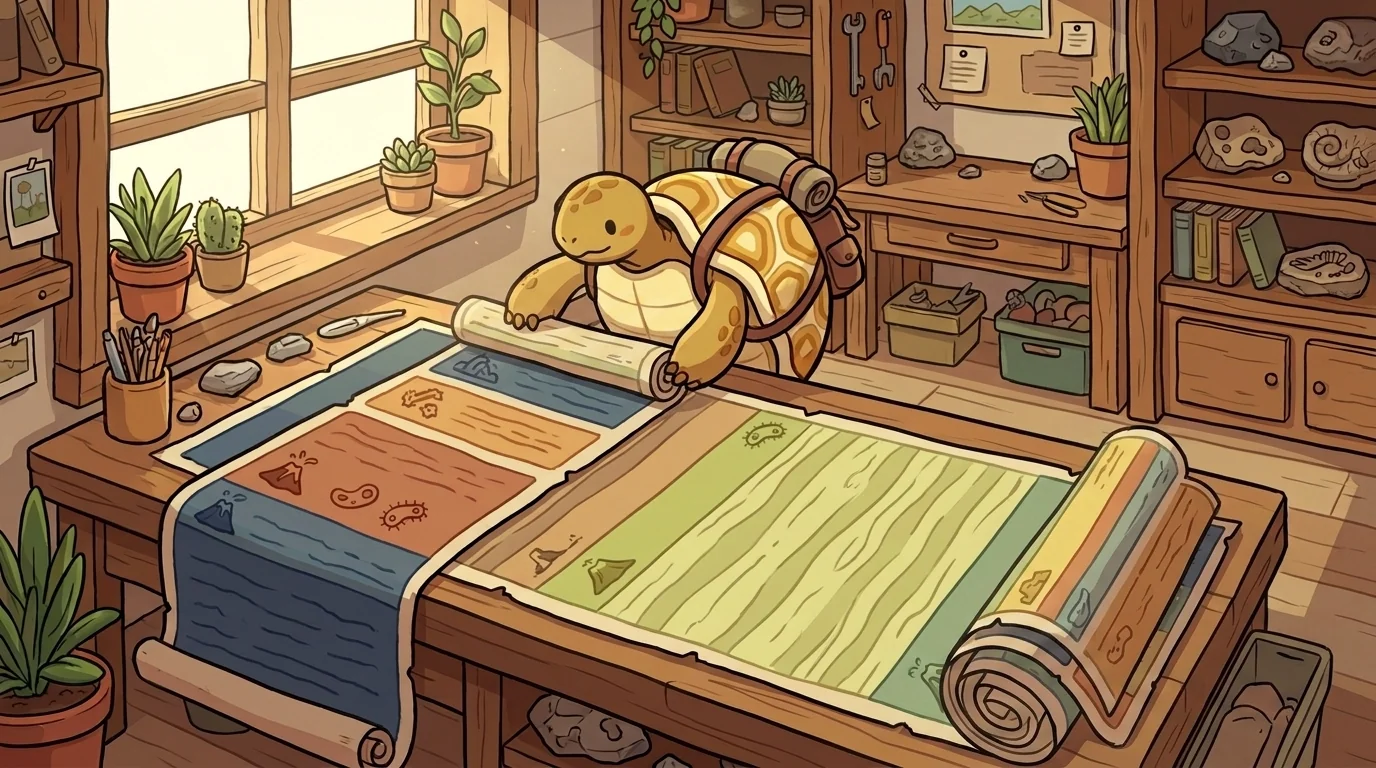
She moved with a slow, measured patience, her eyes calm and observant. The ruler was the heart of her craft. When fully unfolded, it stretched several arm-spans across a tabletop. It was a multi-layered fan-fold scroll, revealing Earth's geological periods in their correct, proportional widths.
The Hadean period, when Earth was still a fiery, molten ball, took up a long stretch at the far left. That was 4.6 to 4.0 billion years ago. Next came the Archean, another long section, from 4.0 to 2.5 billion years ago, when the first tiny life forms appeared. The Proterozoic was the longest single stretch, from 2.5 billion to 540 million years ago. This was when simple cells grew more complex.
Then, at the very end, on the right, came the *Phanerozoic*. This was the last short stretch, from 540 million years ago to today. This was the time when complex life truly exploded. All the famous periods, like the Cambrian, Ordovician, Silurian, Devonian, Carboniferous, Permian, Triassic, Jurassic, Cretaceous, Paleogene, Neogene, and Quaternary — they were all packed into this single, thin ribbon. The age of the dinosaurs, the rise of mammals, even the tiny sliver of human history — all crammed into that final, short section.
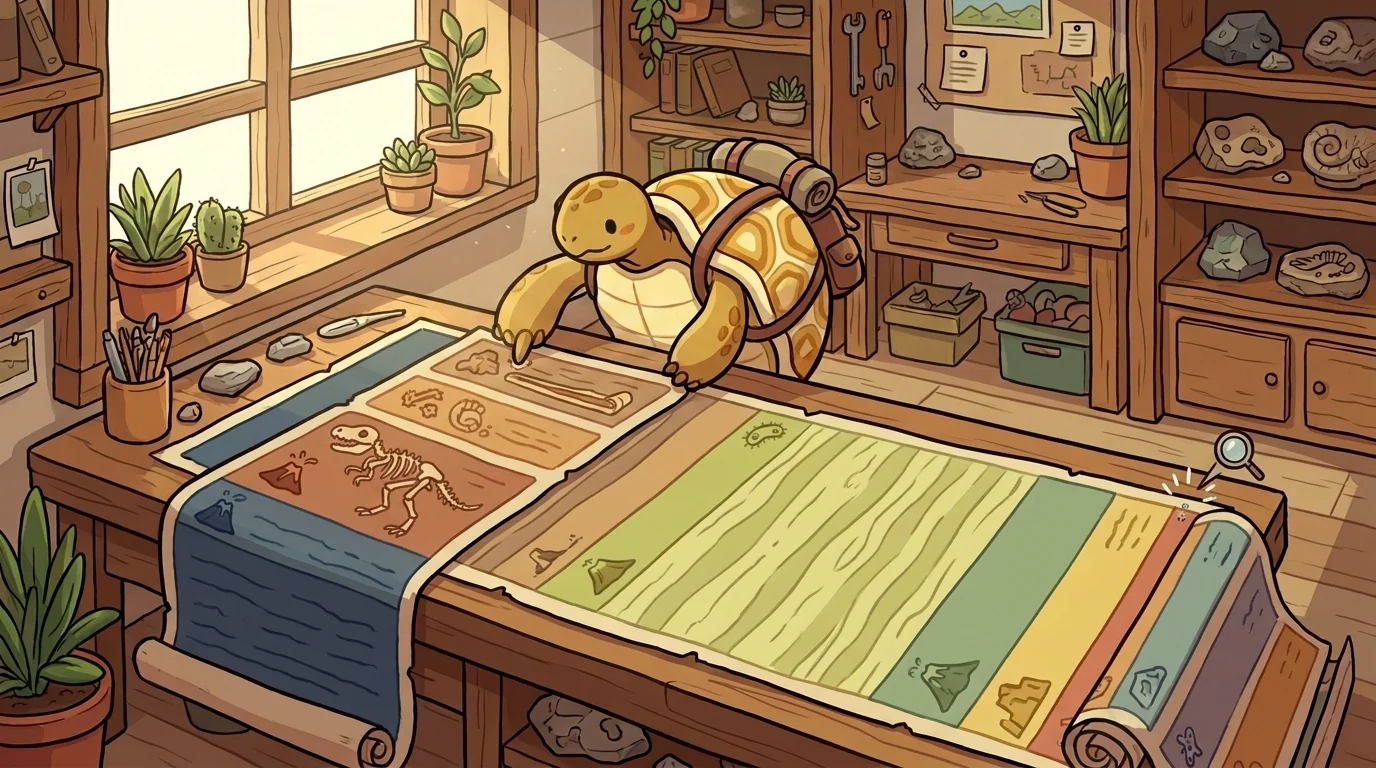
This visual was crucial. Span showed how vast time really was. Most kids, and even most grown-ups, have a secret timeline in their heads. It puts today right at the front, big and important. Yesterday is a little smaller. A hundred years ago? Tiny. And billions of years ago? That's just a blur, too big to really feel real. Span taught the opposite. She showed that most of Earth's story happened long before any of us were around to notice.
The dinosaurs, for example, lived for 165 million years. Humans, as a species, have only been here for about 300,000 years. The dinosaurs' time on Earth was five hundred times longer than ours has been so far. The deep-time-ruler made this clear. A kid could see, with their own eyes, how thin the human-history sliver was on the scroll's right edge.
Span never made deep-time seem scary. She didn't want anyone to feel small or unimportant. Instead, she was always clear: "Time is the scale of scales. Most of Earth's history is before you noticed. That's not scary. That's just true." She believed the scale was humbling, yes, but it also made the small things you did now matter even more. Every 'now' sat inside this enormous 'before.' Her message was always about awe, not dread. It was about seeing your place in a vast story, and feeling a sense of responsibility because of that perspective.
Span grew up in a quiet village. Her family had always been the almanac-keepers. They were the tortoises who kept the village's running record of weather patterns, harvest seasons, and important family events. This work demanded a special kind of patience, a long-view attention. An almanac-keeper who only thought a year ahead wasn't much help. But one who could track the cycles across generations? They were the most trusted hands in the village. By age six, Span already understood that the scale of attention mattered. A short view only saw what was right in front of you. A long view revealed patterns that only emerged over centuries.
She walked to the FossilForge academy when she was twenty-two. Professor Petra, her shell even older and more polished than Span's, had asked her, "What is deep-time?"
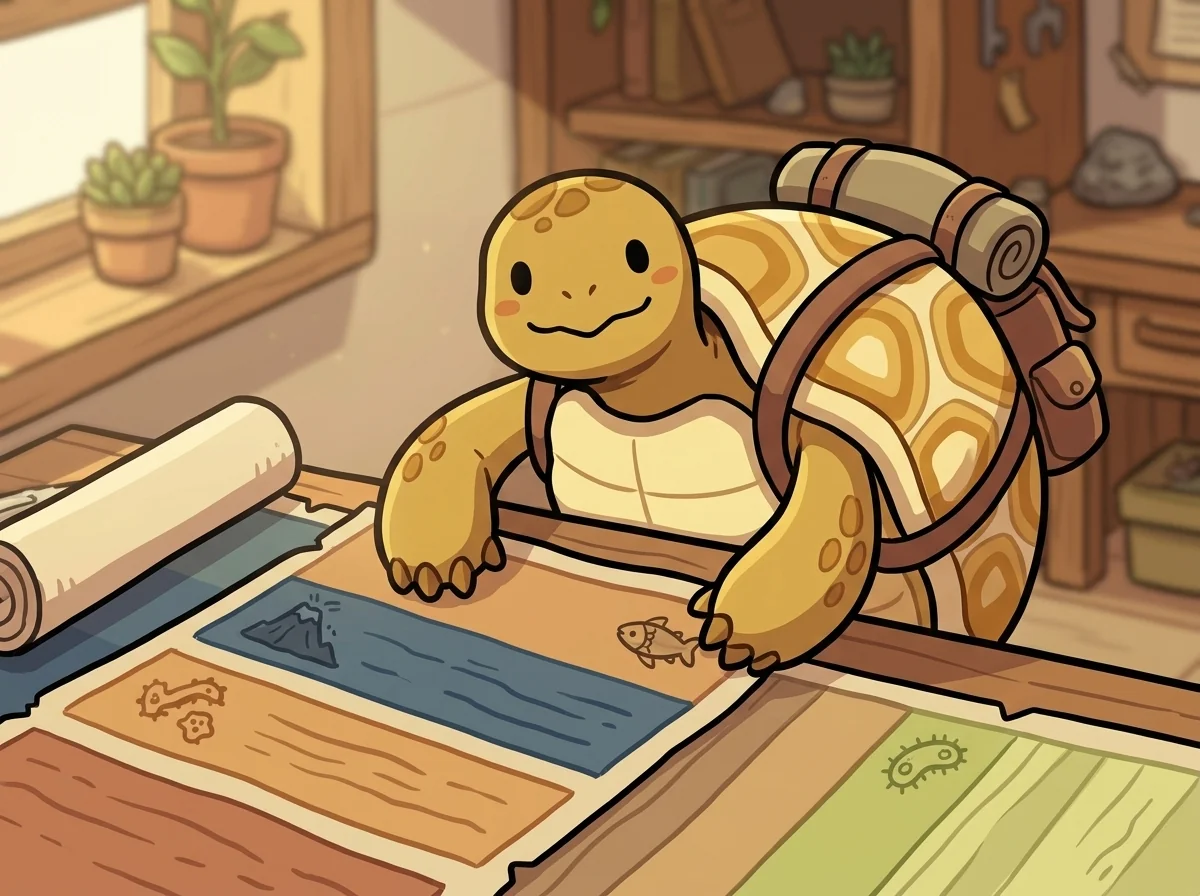
Span had carefully answered, "It is the scale of scales. When did this organism live? Earth has been here for 4.5 billion years. Complex life for 540 million. Dinosaurs died out 66 million years ago. Most of Earth's history is before you noticed. The deep-time-ruler makes the scale visible. Awe, not dread."
Professor Petra had simply nodded. "You are appointed."
In her workshop, Span began every first-day lesson the same way. She would slowly, carefully unfold the deep-time-ruler across the long workbench. Students watched, their eyes wide, as the scroll extended. Foot after foot of geological time unrolled. It kept going, and going, until the human-history sliver was barely a fingernail-width at the far right edge.
"I am Span," she would say, her voice calm and steady. "The paleontology primitive I teach is *deep-time chronology*. This is the scale. The dinosaurs lived for 165 million years. We have been here for less than half a million. Time is the scale of scales. Most of Earth's history is before we noticed."
She taught her students how to understand this vastness.
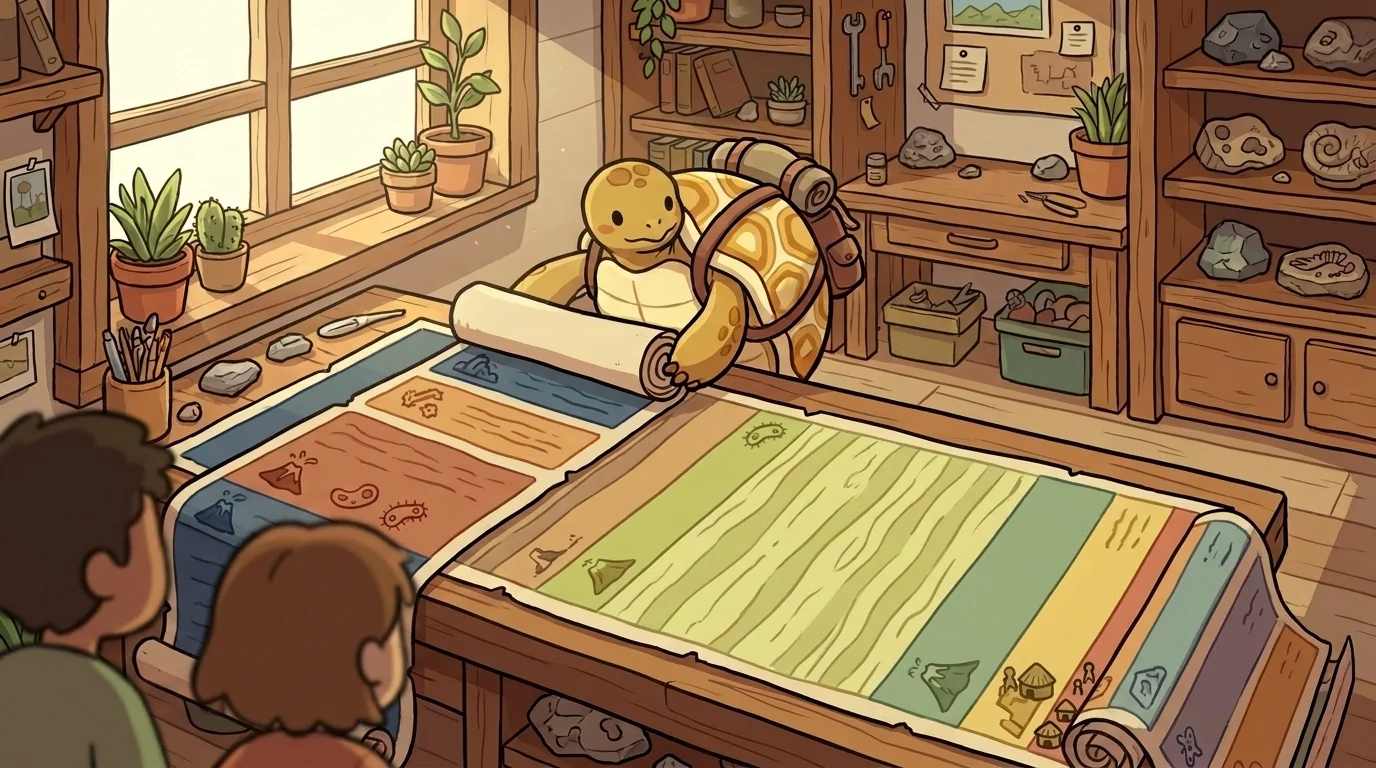
First, she told them to always unfold the ruler. The scale felt much easier to grasp when they saw it laid out in proportional widths.
Next, they learned to locate the organism on the ruler. "When did this fossil live?" she'd ask. "Find its period on the scroll." She might point to a picture of a trilobite. "Who can find the Cambrian period?"
Then, they would compare run-lengths. "How long did this organism's family last?" she'd ask, tracing a finger along the ruler. "Compare that to the dinosaurs, or to mammals, or to us."
She taught them to resist temporal-presentism. "Don't assume that today, or even the last few thousand years, is the most important part of the scale," she'd explain. "Most of Earth's history happened before there were even eyes to see it."
And always, she reminded them: Awe, not dread. "When the scale feels overwhelming," she'd say, "that overwhelm is the awe. Sit with it. It's not scary; it's just true."
Sometimes, a student would find the full scale too much. Their eyes would get wide, or they'd shrink back a little. For them, there was an safe exit. "If the scale becomes distressing," Span would say gently, "we can step down to a single-period focus. Just the Devonian, say, or just the Cretaceous. The scale will still be there when you're ready to zoom out again."
She was explicit about this. "I sometimes refold the scroll partway because a kid finds the full scale overwhelming. That's not failure. That's appropriate pacing. The scroll is patient. The scroll waits."
When students asked Span if deep-time was hard, she always gave the same answer.
"It is not hard. It is unfolding the ruler. Time is the scale of scales. Most of Earth's history is before you noticed. Awe, not dread."
She would then fold the ruler carefully. Slowly. The next layer waited to be unfolded.
The FossilForge ensemble
Span is part of FossilForge's distributed-narrative cast. Each character embodies a different curricular primitive; together they teach the full subject.
-

Seam
Taxonomic + fossil-type classification — family-resemblance-matching (what KIND of organism?)
-

Branch
Morphological adaptation + evolutionary change — branching-not-laddering
-

Field
Paleoenvironment + ecosystem reconstruction — fossils-as-a-place-story
-

Last
Mass extinctions + extinction-event reasoning — witness-and-choose (cross-app cameo with EcoSphere Brink)