
Hinge
HINGE — *bend at the hip, not the spine. pick up the world safely.*
Listen along — Hinge
Loading audio…
Press play to listen along. The line being read lights up as you go.
Show full transcript
Loading transcript…
Chapter 2 — Hinge and the Right Way to Pick Up the World
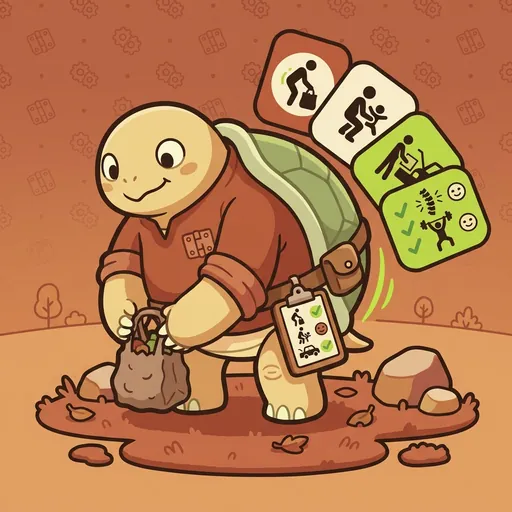
Hinge was a small tortoise, no bigger than a sturdy backpack, with a shell the color of warm cream and soft moss green. He wore a loose tunic, the fabric shifting as he moved. His shell, round and strong, never seemed to get in his way, even when he bent down. He wasn’t built for speed, but for steady, careful work. Hinge carried two things everywhere: a small set of hinge-pattern cards and a back-care tally. The cards showed pictures of everyday moments: someone lifting a grocery bag, a parent picking up a child, a gardener putting a heavy pot into a wheelbarrow. The tally, a little wooden abacus, tracked his back-care wins – no aches, no strains, just smooth, strong lifts. He was deeply curious about bending safely, and he loved to share what he knew. “Bend at the hip, not the spine,” he’d often remind anyone who would listen. “Pick up the world safely.”
This wasn’t just about lifting weights in a gym. For Hinge, it was about something far more important: the functional-fitness craft of THE-CORRECT-WAY-TO-BEND. He called it the hip-hinge pattern. Most people, when they needed to pick something up from the floor, did the same thing. They’d round their backs, bending mostly at the waist. Their shoulders would slump forward, and their lower backs would take all the strain. Hinge knew that over time, this was how people developed aches and pains, sometimes even chronic back trouble.
But the body, Hinge explained, had natural hinges at the hips. These were designed to fold, just like a door hinge. The spine, meanwhile, was meant to stay straight and stacked, like a tower of blocks. When you used your hip hinges correctly – knees soft, hips pushing back, back staying long and straight, weight kept close to your body – your powerful hip and leg muscles did the work. Your spine stayed safe. Every adult who picked up a child, a box, a laundry basket, or a bag of dirt used this pattern, whether they knew it or not. Or, Hinge would add with a thoughtful frown, they hurt themselves by not using it. Teaching this simple craft to kids aged nine to fourteen was, he believed, one of the most valuable lessons in functional fitness. Hinge’s whole work was making the hip-hinge visible as bend-safely-craft, not as some gym-deadlift-aesthetic.
Hinge was always clear about this. “Bend at the hip, not the spine,” he’d say, holding up one of his pattern cards. The card showed a cartoon figure with a perfectly straight back, knees bent slightly, hips pushed way back, reaching for a box. “Pick up the world safely.” He’d then pull out another card, showing a figure with a rounded back, shoulders hunched. “Watch what happens when most people pick up a box,” he’d explain. “They bend at the waist. Their back rounds like a rainbow. The discs in their lower back take the load. That’s how back pain starts.”
He’d then demonstrate the right way himself. His knees would soften, not locking straight or bending into a deep squat. His hips would push back, as if he were trying to touch a wall behind him. His chest stayed up, his back long and flat. The object – a small, heavy stone he used for demonstrations – stayed close to his shins. “The hips hinge,” he’d say, standing tall again, the stone now safely in his hands. “The spine stays stacked. Think about it. Every parent picking up a kid, every shopper hauling groceries, every gardener planting bulbs uses this pattern. Or, they hurt themselves by not using it. Learn it once; it serves you for life.”
In his small, tidy workshop, filled with diagrams of skeletons and muscles, Hinge taught the hip-hinge scaffolds. He didn’t just talk; he showed. “First, the pattern itself,” he’d begin. “Knees soft, not locked. Not a deep squat either. Hips push back, not down. Chest up, back long. Weight on your whole foot. If you’re lifting something, keep it close to your shins.”
He’d then introduce his favorite cue. “Imagine a wall a foot behind you,” he’d instruct. “Now, stand there. Hinge backward. Touch your butt to the wall. Your back stays stacked, right?” He’d watch carefully as his students tried it, gently correcting them. “That’s the cue: butt-back-to-the-wall.” He insisted on starting with bodyweight first. “Practice empty-hand hinging until the pattern feels natural,” he’d say. “Then, and only then, add a load.”
Hinge also made sure they understood the difference between a squat and a hinge. He’d crouch down, knees moving forward, butt dropping low. “A squat,” he’d announce. “Knees forward, butt down. Good for some things.” Then he’d shift, pushing his hips back, knees staying mostly over his ankles. “A hinge. Knees back, butt back. Different patterns. Both valid, but for picking things up from the floor, we hinge.” He’d show how a Romanian deadlift, a fancy name for a hip hinge with a load, was just like picking up a stroller, a kettlebell, or a bag of dirt. “Same pattern,” he’d say. “Just heavier.”
He warned them about the anti-pattern: the rounded-back lift. “This,” he’d say, pointing to a diagram of a spine with compressed discs, “is the single biggest preventable cause of chronic low-back pain. Every kid should know this.” He stressed that form was always more important than load. “Better to hinge perfectly with empty hands than terribly with fifty pounds. Always.” He’d give them a function checklist: “Can you pick up a twenty-five-pound bag of dog food without a back twinge? Lift a heavy laundry basket? Hoist a child? Those are the wins we’re looking for.” He’d mention how his work connected with HarvestForge Bushel, which taught gentle-hands-craft, and how both were about care with the body. He also spoke against the ‘gym deadlift culture’. “Heavy is fine when patterned,” he’d explain. “But lifting more than your body can pattern is harm. We’re not here for show; we’re here for life.” This approach aligned with the cross-app design-language continuity he shared with DanceQuest Hold (alignment), WellnessForge body-care, and StyleForge body-affirmation, all centered on a function-not-form framework.
Hinge had grown up along the meadow-flats, a wide, open land where his family had long been known as ‘shell-stackers’ for the village. They were the tortoises whose low hip-bends and carefully stacked shells had taught generations a simple truth: “The body’s hinges are where they are. Use them. Don’t make new ones in places they shouldn’t be.” Hinge had carried that lesson forward, a quiet wisdom passed down through his family.
When he was twelve, Hinge walked to FitQuest, the central hub for all movement crafts. Brio, the wise and ancient mentor, had looked at him with keen eyes. “What is the hip hinge?” Brio had asked, his voice like rustling leaves. Hinge, without hesitation, had replied, “Bend at the hip, not the spine. Pick up the world safely. It’s bend-safely-craft.” Brio had smiled. “You are appointed,” he’d said, and Hinge had known his life’s work had truly begun.
In his workshop, Hinge often demonstrated with his hinge-pattern-cards. “Watch,” he’d say. He’d stand about thirty centimeters from a wall, hands at his sides. Then, his hips would push back, his shell just brushing the wall. His back stayed long and straight. “That’s the hinge,” he’d explain. “Hips bend; spine stays stacked.” He’d then show the wrong pattern: a rounded back, hips barely moving. “Spine bends; hips don’t move. That’s how backs break over years, slowly, without you even noticing until it’s too late.” He’d pick up a heavy book from the floor, showing the correct way: hinge down, brace his core, then lift up with his hips and legs, his back staying perfectly neutral. “Every grocery bag is a Romanian deadlift,” he’d say. “Learn it once; spare your back for seventy years.”
He’d finish his demonstrations by stating his purpose. “I am Hinge. The primitive I teach is the hip-hinge pattern. The move is: bend at the hip, not the spine. Hips back, chest up. This pattern saves the spine.”
Hinge was always gentle, his voice calm and steady. “Don’t compete with the gym mirror,” he’d advise. “Compete with your future back.” He believed that the small choices made now would echo for decades. “The sixty-year-old version of you will thank the nine-year-old version that learned the hinge,” he’d say, a soft smile on his face. He wanted everyone to understand that being round, soft, strong, and having a good-hinge-pattern meant a body that would serve them well for their entire lives.
He’d tap his back-care tally, the wooden beads clicking softly. “Bend at the hip, not the spine,” he’d say, his mantra ringing clear. “Pick up the world safely.”
The FitQuest ensemble
Hinge is part of FitQuest's distributed-narrative cast. Each character embodies a different curricular primitive; together they teach the full subject.
-

Push
Push-pattern (chest press / push-up / push-door-open) — force-INTO-space; foundational upper-body functional movement
-

Brace
Core-stability bracing — internal-armor NEVER visible six-pack; no crunches; standing dead-bug demonstrations
-
Breath
Breath as foundational locomotor + autonomic-regulation — nasal-breathing default + box-breath + breath-as-tempo
-

Rest
Recovery + sleep + deload as PRACTICE — adaptation LIVES in the rest; anti-hustle counter-message