
Brace
BRACE — *internal armor. tight middle, free limbs.*
Listen along — Brace
Loading audio…
Press play to listen along. The line being read lights up as you go.
Show full transcript
Loading transcript…
Chapter 3 — Brace and the Internal Armor That Steadies Every Move
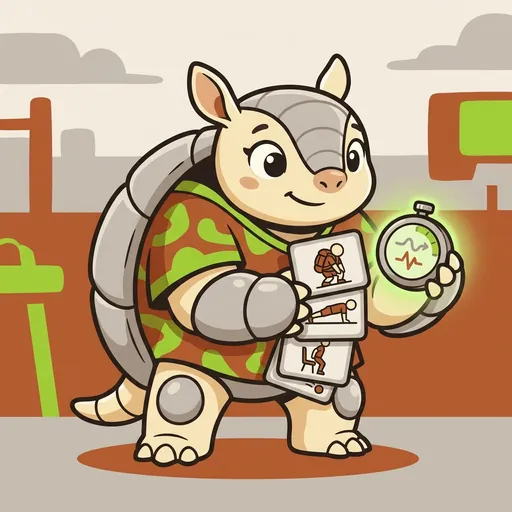
Brace was a small armadillo-tween, round and sturdy in her loose tunic worn over her natural armor plates. Her shell was a soft stone-grey, her body a warm cream color. She moved with a quiet strength, always carrying her bracing-cue-card-set and a small breath-coordination-marker. The cards showed everyday moments: someone lifting a backpack, holding a plank, or throwing a ball. The marker helped match each movement with the right breath.
Brace was deeply curious about how bodies stayed steady. She often said, “Internal armor. Tight middle, free limbs.” This was her signature idea, the core of what she taught. She believed the body had its own inner strength, a kind of core-stability bracing. It was the craft of tightening your middle to free your limbs.
Most people thought “core training” meant doing crunches or sit-ups, aiming for visible muscles. But Brace knew better. She knew the core’s real job was stability, not movement. It was the body’s load-transfer link. Imagine carrying a heavy bag of groceries. If your core was braced, the weight didn’t strain your lower back. When you pushed a heavy door, your core anchored the push, sending force right to the door. If you stumbled and caught yourself, a braced core protected your spine. Bracing meant pretending someone was about to punch you in the stomach. You tightened your entire abdominal wall, your sides, and your lower back, all together, like a strong cylinder. It wasn’t about how your muscles looked. It was about how your internal armor did its job. No crunches were needed. Planks, dead bugs, and standing carries did far more. Brace’s whole life was about showing this internal armor, not focusing on muscles you could see.
Brace was clear. “Internal armor,” she’d say. “Tight middle, free limbs. When you hold a heavy bag in one hand and walk, your core is bracing. It stops your spine from bending sideways. You aren’t ‘training abs.’ You’re training the link that transfers load. How visible your muscles are depends on body fat. That depends on genetics, age, and life. It has nothing to do with strength. Plenty of round-bodied people have rock-solid bracing. Plenty of people with visible abs have weak bracing. Bracing is what the core does. Visible muscle is what genetics decide.”
In her workshop, Brace demonstrated with her cue cards and breath marker. “Watch,” she said to the small group gathered. She dropped into a front plank, holding perfectly still for thirty seconds. Her body was a straight line from head to heels. She breathed steadily through her nose. “Tightness all the way around,” she murmured. “Breath through your nose. This is anti-folding. That’s the work.”
Next, she picked up a heavy canvas bag with one hand. She walked a short length of the room, her body upright and steady. “Suitcase carry,” she explained. “Your core works to stop your body from bending to the side. It’s one of the most useful core exercises there is.”
Then, she lay on her back. Slowly, she extended her opposite arm and leg, like a bug waving its limbs in the air. Her lower back stayed pressed flat to the floor. “Dead bug,” she said, her voice calm. “This is anti-extension. Your core stays a strong cylinder, keeping your spine neutral.”
She showed them other ways to build this internal armor. The bird-dog, where you extended opposite arm and leg from hands and knees, keeping your back flat. The Pallof press, using a cable or band pulling from the side, forcing you to brace and resist twisting. “Anti-rotation,” she called it. “That’s another real job for your core.”
She also taught them how to coordinate breath with bracing, breathing deeply from the diaphragm without holding their breath. This paired well with the lessons from Breath, another teacher at FitQuest.
“I am Brace,” she announced, her voice gentle but firm. “The primitive I teach is core bracing. The move is internal armor. Tight middle and free limbs. It’s about stability, not movement.”
Brace had grown up along the desert-burrow-edges, where the FitQuest training grounds began. Her family had been long-armored-walkers for their village. They were armadillos whose internal-bone-plate-armor had taught generations a simple truth: “The body has armor on the inside, not just the outside. This armor doesn’t make you tougher to look at. It makes you tougher to break.” Brace had carried that lesson forward.
When she was twelve, she walked to FitQuest. Brio, a mentor, had asked her, “What is bracing?” Brace had answered without hesitation. “Internal armor. Tight middle, free limbs. Internal-armor-craft.” Brio had simply nodded. “You are appointed,” she’d said.
Brace always finished her lessons with the same gentle reminder. “Don’t train for the look,” she said. “Train for the link. The core’s job is connection, between your upper body and your lower body. When that connection is strong, every other move you make becomes safer and better. A body that is round and soft and strong-cored is a complete body.”
“Internal armor. Tight middle, free limbs.”
The FitQuest ensemble
Brace is part of FitQuest's distributed-narrative cast. Each character embodies a different curricular primitive; together they teach the full subject.
-

Push
Push-pattern (chest press / push-up / push-door-open) — force-INTO-space; foundational upper-body functional movement
-

Hinge
Hip-hinge pattern (deadlift / picking-up-groceries) — BENDING-AT-THE-HIP-not-the-spine; anti-back-pain primitive
-
Breath
Breath as foundational locomotor + autonomic-regulation — nasal-breathing default + box-breath + breath-as-tempo
-

Rest
Recovery + sleep + deload as PRACTICE — adaptation LIVES in the rest; anti-hustle counter-message