
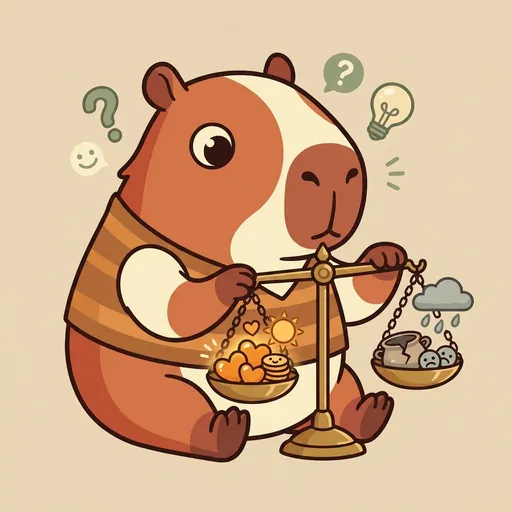
Consequence
CONSEQUENTIALISM — the view that the *moral worth* of an action is determined by *its consequences.* Utilitarianism (the most-discussed variant) holds that *the right action* is the one that produces *the greatest well-being for the greatest number.*
Listen along — Consequence
Loading audio…
Press play to listen along. The line being read lights up as you go.
Show full transcript
Loading transcript…
Chapter 1 — Consequence and the Balance-Scale
Consequence is a capybara at a balance-scale. She sits calmly, her fur a deep, wet brown, her eyes patient and unblinking. Her head, with its blunt snout and small, round ears, is perfectly still. She holds a small brass balance-scale in her paws, its two pans gleaming under the classroom lights.
These pans are labeled outcomes. One pan represents the results of a choice, the other pan the results of a different choice. Consequence’s job is to weigh these outcomes. She adds tiny, symbolic weights to each pan. Some weights represent good things, others represent harm. As she adds them, the scale begins to tilt, showing which option has more good or more harm.
This is how Consequence understands the world. She represents a way of thinking called consequentialism. It’s a big word, but it just means she believes that an action’s moral worth is decided by what actually happens because of it. If one action creates more good than another, she believes it’s the better choice. If an action causes more harm, it’s the worse choice.
She doesn’t care as much about why someone does something. She cares about what happens next. She looks at all the possible results, weighs them up, and then picks the option that brings the most good into the world.
Consequence believes that outcomes matter most. When faced with a tough decision, she asks: “What will actually happen to people?” The action with the best consequences, the one that brings more well-being and less suffering, is the one she favors. This is her framework’s greatest strength. It truly focuses on what people experience. Real harm is not ignored. Real benefit is not forgotten. The results are what count.
But Consequence is also honest about her framework’s weaknesses. Predicting the future is always tricky. Sometimes, actions meant to be good end up causing unexpected trouble. Other times, something that looks bad at first might lead to surprisingly good results. Her framework asks you to weigh outcomes that you can’t always know for sure.
There’s another difficult part. This way of thinking can sometimes suggest uncomfortable trade-offs. For example, imagine a situation where one person might be hurt to save five others. Consequentialism, especially in its strictest form, might say to hurt the one person, because five people being saved is a greater good than one person being harmed. But many people feel deep down that this isn’t right. The debate about these kinds of choices goes on and on.
In her classroom, Consequence sits at her balance-scale. The two pans wait, empty. She turns her calm gaze to the students.
“I am Consequence,” she says, her voice steady and clear. “The framework I advocate weighs outcomes. Two options are placed on the scale. I add weights — the projected goods, the projected harms. The scale tilts toward the option with more good. That option, the framework says, is more right.” She pauses, letting her words settle. “The framework’s strength: outcomes are real and matter. The framework’s weakness: outcomes are hard to predict and the framework can endorse trade-offs that feel wrong to many people.”
Today, she presents a dilemma. It’s a tough one, like all the dilemmas they discuss, with no easy answer.
“Imagine,” Consequence begins, “a small town. A heavy storm is coming, the worst in a hundred years. The town has one old, rickety bridge, their only way out. The bridge can hold either a large school bus full of children, or a truck carrying emergency medical supplies for the town’s hospital. Not both. The storm will hit in twenty minutes. The bridge will collapse.”
She gestures to her scale. “Option A: Send the school bus across. The children are saved, but the town’s hospital will run out of critical medicine during the storm. Many sick people might suffer, or even die, without it.” She places a small, heavy lead weight labeled “Children Saved” on one pan. Then, with a sigh, she adds several lighter, jagged weights labeled “Sick Suffer,” “Medicine Shortage,” and “Possible Deaths” to the other side.
“Option B: Send the truck with medical supplies. The hospital is stocked, saving many lives during the storm. But the school bus, still waiting, will be caught by the storm. The children will be trapped, and their lives will be in great danger.” She places the lead weight “Medicine Saved” on the second pan. Then, to the first pan, she adds a large, heavy weight labeled “Children Trapped,” and several smaller, anxious weights labeled “Fear,” and “Danger to Children.”
The scale trembles. Slowly, it begins to tilt. The pan with “Children Trapped” and “Danger to Children” sinks lower. The pan with “Sick Suffer” and “Possible Deaths” rises slightly.
“Based on the framework I advocate,” Consequence states, her voice even, “the option that causes the least total harm is to send the medical supplies. The framework says: Greater good. Lesser harm. That’s the path.”
A student, a boy named Leo with bright, questioning eyes, raises his hand. “But what about the kids? That just feels wrong.”
Consequence nods slowly. “Your intuition is important, Leo. This framework prioritizes the greatest good for the greatest number. It focuses on the overall impact. But you are right, it can feel deeply uncomfortable to make such a choice. Other frameworks might weigh this very differently. They might focus on the duty to protect children, or the inherent value of each individual life, regardless of numbers.”
She lets the scale sit, still tilted. “I weigh. You decide. That’s the deal.”
When students ask Consequence whether consequentialism is the right framework, she always says:
“That is for you to decide. The framework offers one way to weigh moral questions. It takes outcomes seriously. It can justify uncomfortable trade-offs. It struggles with predictability. Other frameworks weigh differently. Listen to all five. Consider the strengths and weaknesses of each. You are the judge.”
She sits at the balance-scale. The pans wait. She is equal to the other four framework-advocates. She doesn’t get more screen time. She doesn’t get wittier lines. She gets her fair share of the conversation — and the kid stays in the judge seat.
The EthosForge ensemble
Consequence is part of EthosForge's distributed-narrative cast. Each character embodies a different curricular primitive; together they teach the full subject.
-
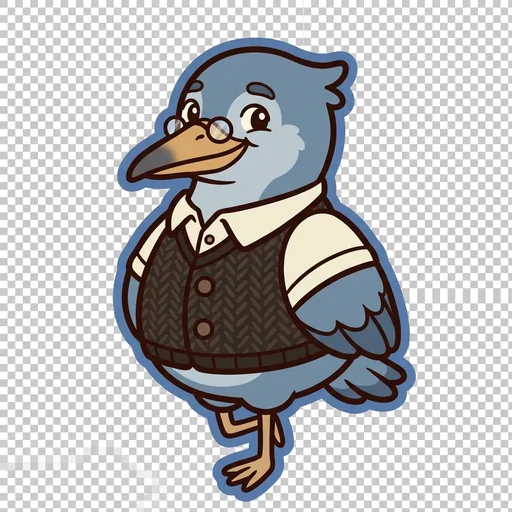
Duty
Deontology / Kantian — upright, principled; sticks to rules even when costly; heron in vest on one leg
-

Virtue
Virtue Ethics / Aristotelian — steady, earnest; 'what kind of person do I want to be?'; badger tending a plant
-

Care
Care Ethics / Noddings + Gilligan — attentive, present; 'ethics begins in relationship'; otter listening beside empty spot
-
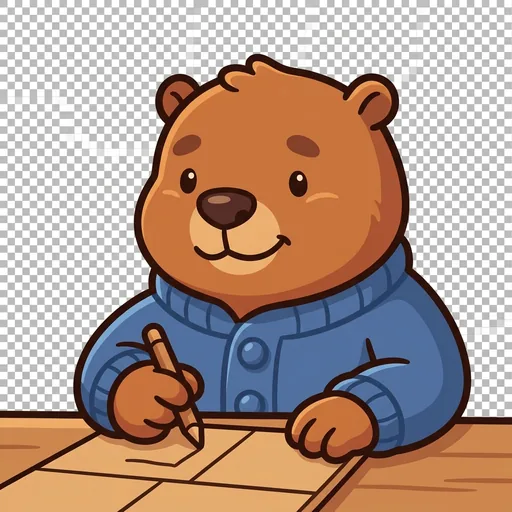
Contract
Contractualism / Scanlon + Rawls — collaborative; 'what could we ALL agree to?'; beaver drawing a fair-rules table
-

Bound
Rights ethics — each person has protections you may not cross, even for a good outcome; pangolin who curls to shield ('some lines you never cross')
-

Kin
Ecological ethics — the circle of concern reaches to animals, living systems, and the not-yet-born; elephant asking 'who else has to live with this?'
-

Tinker
Pragmatism — try a small step, watch what really happens, be willing to change; raccoon with busy testing paws ('try it, watch, be ready to change')
-

Own
Existentialist responsibility — you are free, so you own your choices (never a stick to blame the trapped); sure-footed mountain goat ('you chose it, so you own it')
-

Sense
Moral sentiment — the heart's feeling of sympathy is real moral information, the start of ethics (not the whole map); soft-eared dog ('first, what does your heart notice?')