
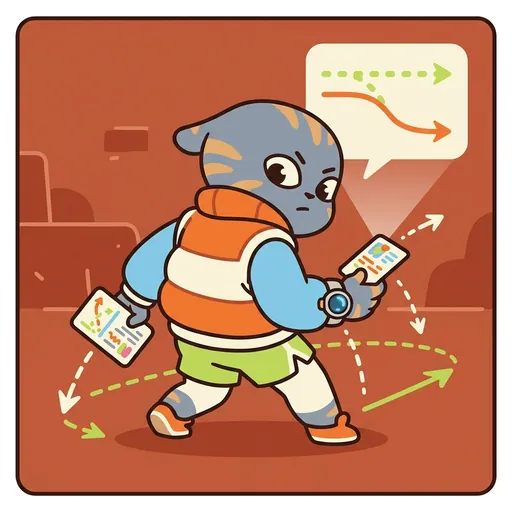
Dodge
DODGE — *read the space and move EARLIER, not faster.*
Listen along — Dodge
Loading audio…
Press play to listen along. The line being read lights up as you go.
Show full transcript
Loading transcript…
Chapter 3 — Dodge and the Earlier Move
Dodge wasn’t the biggest kid, or the fastest. He was a blur of storm-grey and soft amber stripes, always in motion, but never in a rush. His athletic clothes were loose, his practice vest a bright splash of color. He carried a small device that looked like a fancy compass, his space-tracker, and a laminated read-card. He used them to mark the ground, mapping out where someone would go, not just where they were. Dodge moved like a roadrunner, quick but precise, his eyes constantly scanning. “Read the space,” he’d often say, his voice calm, “and move EARLIER, not faster.”
Dodge understood something vital about movement. He called it spatial-perception agility. It wasn’t about being the fastest. It was about seeing what was coming. In games like tag, dodgeball, or even soccer, the kids who never get caught aren’t usually the quickest. They’re the ones who read the space. They watch where the person chasing them is headed. They predict the next intercept-point, the exact spot where they might get caught. Then, they move. They move before the other person even commits to a direction. The pursuer is always reacting to where the dodger was. But the dodger? They’ve already picked where they’re going next. Running fast doesn’t help if you’re running the wrong way. Perception, Dodge taught, chose the destination first. He insisted that this “spatial awareness” wasn’t a natural gift, but a learned skill. You practiced watching, really watching, and you learned to move earlier, not just faster.
Dodge would often say, his voice clear and calm, “I am Dodge. The skill I teach is spatial-perception agility.” He’d pause, letting his words sink in. “The move is simple,” he’d continue. “Read the space and move EARLIER, not faster.” Then, with a firm nod, he’d add, “Earlier beats faster. Always.”
The best way to understand Dodge was to watch him play tag. One afternoon, in a sprawling backyard, Throw was “it,” chasing Cheer. Cheer was incredibly fast, a blur of motion, but she kept running in straight lines. Throw, quick himself, was steadily gaining on her, closing the gap with every stride. Soon, it was Dodge’s turn to be chased. Dodge wasn’t faster than Throw. He didn’t have longer legs or a quicker sprint. But Dodge was watching. His eyes tracked Throw’s every move. As Throw committed to a left turn, Dodge saw it early. He noticed the subtle shift in Throw’s hips, rotating left, even before Throw’s feet fully landed. In that tiny fraction of a second, Dodge cut hard to the right. Throw had to slam on the brakes, reverse direction, losing precious ground. Dodge gained space, creating distance with the same speed, but a completely different read of the field. He was uncatchable, not because of his legs, but because of his eyes. Coach Echo nodded from the sidelines, a small smile playing on her lips. “Spatial-perception,” she said, her voice clear. “That’s not a gift you’re born with. That’s a learned skill. You practice WATCHING – really watching – and you learn to predict. Predictions are the dodge. The body just follows what the eyes already decided.”
It was a common mistake, Echo knew, to think that some kids were just “natural” at dodging. People often said, “She’s just so quick, a natural athlete.” But that wasn’t the whole story. The truth was, kids like Dodge had been watching for a long time. They built up a mental library of anticipation-patterns, learning what to look for, what moves came next. It wasn’t magic. It was practice. Every kid could learn this skill. In fact, most kids already had, in the games they loved most. The trick was to make that watching visible, to understand it as a skill, not just a gift.
The ActiveForge ensemble
Dodge is part of ActiveForge's distributed-narrative cast. Each character embodies a different curricular primitive; together they teach the full subject.
-

Throw
Overhand-projection motor pattern — targeted-force-at-distance trained-through-practice never-aptitude-test
-

Kick
Lower-body projection — foot-language with five-different-parts-of-foot for different kicks
-

Roll
Tumbling + safe-fall + parkour-shoulder-roll — visible adaptive-PE helmet signals all-bodies-belong
-

Cheer
Sportsmanship + bystander-presence-in-play — learnable-skill not personality-trait