STEAM
InquiryForge
Design the experiment, not just memorize the answer — an experimental-design / scientific-method game for ages 15–18. Given a phenomenon, form a hypothesis, design a controlled experiment (pick the variable, hold controls, spot confounds), predict, run a deterministic sim, analyze signal-vs-noise, and build or critique an argument. The scientific method itself — process, not facts.

#6B4FB0 Distributed-narrative cast
Meet the cast
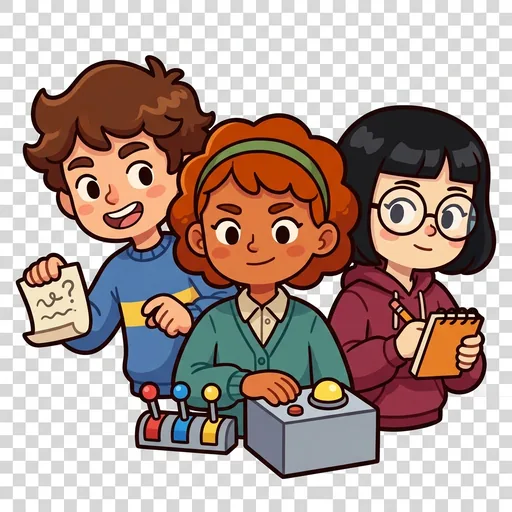
InquiryForge's adapted-DN-S cast (ages 15–18, realistic researcher personas — no mascots, per R-OLDER-TEEN-DN-ADAPTED) each embody one scientific-method primitive: turning a hunch into a testable if-then (Hattie), changing exactly one thing (Cal, control the variable), spotting the hidden third variable (Fenn, confound-hunter), repeating a study to see if it holds (Ravi, replication), refusing to call a link a cause without a controlled test (Corvo), checking the sample represents the whole (Sana, sampling & bias), turning a fuzzy idea into a measurable one (Opal, operationalize), separating signal from noise (Nia, data analysis), and demanding the evidence behind every claim (Argus, peer critique / ADI). Mentor Sol frames the investigation, keeps it honest, and guides reflect-on-method.
Hattie
Hypothesis / testable prediction — turns a hunch into a testable if-then before touching data
Cal
Control the variable — changes exactly ONE thing, holds the rest constant
Fenn
Confound-hunter — spots the hidden third variable that would fool you
Ravi
Replication / reproducibility — repeats the study to see whether the result holds
Corvo
Correlation ≠ causation — refuses to call a link a cause without a controlled test
Sana
Sampling & bias — checks the sample represents the whole before generalizing
Opal
Operationalize / measurement — turns a fuzzy idea ('healthy') into a measurable one
Nia
Data analysis / signal-vs-noise — separates the real pattern from random variation
Argus
Peer critique / argumentation (ADI) — challenges every claim and demands the evidence
Sol
Mentor — frames the investigation, keeps it honest, guides reflect-on-method (the AAR guide)
What's inside
Learning goal
Design the experiment, not just memorize the answer — an experimental-design / scientific-method game for ages 15–18. Given a phenomenon, form a hypothesis, design a controlled experiment (pick the variable, hold controls, spot confounds), predict, run a deterministic sim, analyze signal-vs-noise, and build or critique an argument. The scientific method itself — process, not facts.
Question kits
16 curriculum-aligned kits × 25 questions = 400 questions per app, mapped to recognized standards.
On-device AI mentor
FoundationModels-powered hints, feedback, and adaptive difficulty — all running locally.
Mentored by Sol — on-device AI, no data leaves the device.
How InquiryForge handles your kid's data
- ✅ All progress, settings, and AI-generated content stays on the device
- ✅ No analytics, no tracking, no third-party SDKs
- ✅ No ads, no in-app purchases — you pay once
- ✅ COPPA compliant under the 2026 FTC amendments
- ✅ Parental controls + session limits + content filters built in
InquiryForge runs on ForgeKit — the open-source Swift Package Manager framework that powers every Spark & Anvil app. ForgeKit ensures consistent accessibility, COPPA compliance, and design language across the portfolio, so your kid's progress and preferences feel coherent across every app they touch.
Coming to the App Store
InquiryForge is in active development. Email us to hear when it ships — no marketing, no spam, just a one-shot launch announcement.
Email me at launch